Claude Fable 5.1 and GPT-6 Astra shipped three days apart in September 2026, Anthropic on September 1 and OpenAI's general availability on September 4, and they landed at the exact same headline API price: $10 per million input tokens, $50 per million output tokens. That is unusual enough to be the actual story. When two frontier labs price identically, the decision stops being about cost and starts being about which model finishes your specific kind of automation task, and which one you can trust with it.
Here is a practical read on both, built for the question that actually matters to a business evaluating them: not "which model wins," but which one to put in production on which kind of automation work.
What Shipped, and When
Anthropic released Claude Fable 5.1 alongside a restricted twin, Mythos 5.1, on September 1, 2026. Fable 5.1 is the generally-available flagship, positioned above Opus 5 (July 2026) and Sonnet 5 (June 2026) in Anthropic's lineup, for coding, knowledge work, and long-horizon agentic and scientific tasks. Mythos 5.1 is the same underlying model with lighter safeguards, available only to vetted cybersecurity and life-sciences organizations, so treat Fable 5.1 as the product an ordinary business can actually call.
GPT-6 Astra had a limited preview on September 3 and went generally available September 4 across ChatGPT (Plus, Pro, Business, Enterprise), the OpenAI API, Azure AI Foundry, and AWS Bedrock. It supersedes the GPT-5.6 line (Sol, Terra, Luna) and the 5.4/5.5 models before it. It was trained at OpenAI's Stargate site in Texas on more than 100,000 GPUs, and introduces a "recurrent depth" (looped-transformer) architecture with a user-controlled reasoning-effort dial from low to max.
Headline Specs and Pricing, Side by Side
| Claude Fable 5.1 | GPT-6 Astra | |
|---|---|---|
| Released | Sept 1, 2026 | GA Sept 4, 2026 |
| Input / output per 1M tokens | $10 / $50 | $10 / $50 |
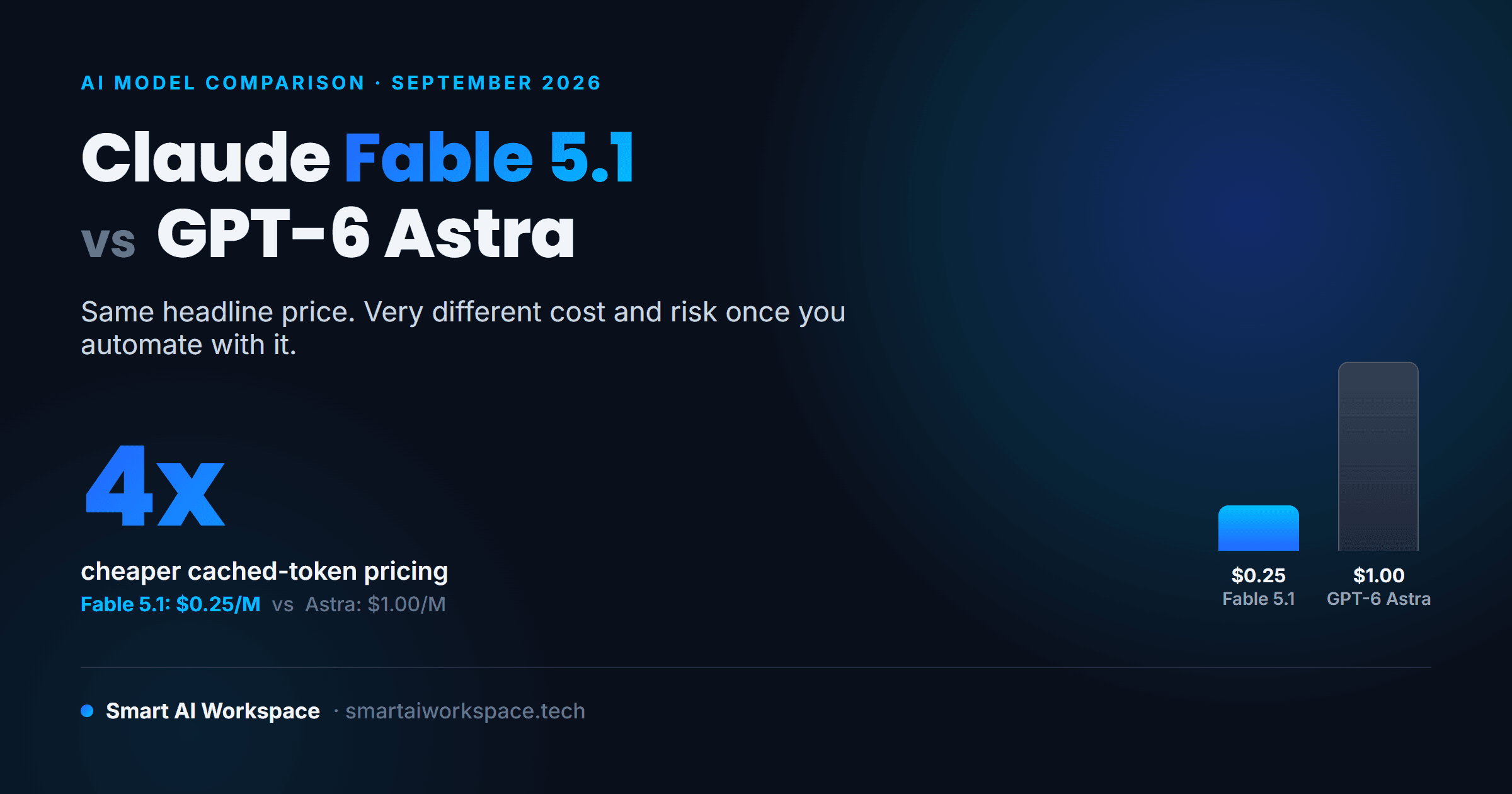
| Cached input per 1M tokens | $0.25 | $1.00 |
| Context window | 1M tokens | ~1.05M tokens (922K in / 128K out) |
| Architecture | Adaptive/extended thinking, effort tiers Low-Max | "Recurrent depth" looped transformer, reasoning-effort dial low-max |
| Access | API, Bedrock, Vertex AI, Azure, Claude Code, Enterprise | ChatGPT, API, Azure Foundry, AWS Bedrock |
| Published cyber risk rating | Not rated Critical | Rated "Critical" (OpenAI Preparedness Framework) |
Both figures for input/output pricing come straight from each vendor's own pricing page. The context windows are close enough that neither is a deciding factor on its own. The two numbers worth sitting with are the cache price and the risk rating, because they point at different automation decisions.
Claude Fable 5.1: Built for Long, Agentic Runs
Anthropic's own benchmark numbers show Fable 5.1 pulling ahead of both its predecessor and its own cheaper sibling model on exactly the tasks that decide whether an agent can run unattended: 55.8% on Terminal-Bench agentic coding (versus 52.3% for Opus 5 and 42.0% for Fable 5), 60.9% on Humanity's Last Exam, and 52.6% on Terminal-Bench-Science (versus 29.0% for Opus 5 and 24.7% for Fable 5). Anthropic and launch partners also reported real research use, including a protein-binder design task with a claimed 10x affinity improvement and GPU kernel optimization up to 2.5x faster, the kind of long-horizon, multi-step work that automation vendors care about more than a leaderboard score.
The pricing story matters as much as the benchmarks. Cached reads dropped to $0.25 per million tokens, a 75% cut from the prior generation, and Anthropic reports roughly 25% lower cost on typical workloads and up to 45% lower on highly agentic ones. Cached context is exactly what a production automation burns through: the same system prompt, the same codebase, the same knowledge base, read again on every step of a long agent run. Early partners summed it up as "Fable-level intelligence, Opus-level price."
On the safety side, Anthropic reports 85% fewer false-positive refusals on benign biology-related requests and roughly 60% fewer cybersecurity intervention triggers per session than the prior generation, plus new anti-distillation restrictions on the API. That is a model getting less trigger-happy about legitimate business use, not less careful.
GPT-6 Astra: A Higher Reasoning Ceiling, Reported
GPT-6 Astra's headline numbers are striking, and OpenAI's own announcement page blocks automated access, so these are drawn from independent analysis (Vellum) and, for ARC-AGI-3, directly from ARC Prize, the organization that runs that benchmark. Astra scores 72.6% on OSWorld 2.0 (computer use), roughly 47% faster per task than its predecessor, and 97.6% on FrontierMath Tier 4. On ExploitBench it hits 100%, and in a contamination-controlled internal test using recent V8 vulnerabilities it reportedly found two previously-unknown zero-days during evaluation.
ARC-AGI-3 is the number that needs the asterisk, and ARC Prize's own writeup gives the precise version: Astra scores 62.7% under a standard, stateless harness, and 99.9% under OpenAI's "Provider Adapter" harness, which preserves reasoning state between requests and lets the model reuse prior work. That is a 37-point swing between "the model, called normally" and "the model, called with a harness built to flatter it." ARC Prize itself is explicit that saturating the benchmark "would not represent proof of achieving AGI." If a vendor pitches you an Astra benchmark number, ask which harness produced it.
The more concrete fact about Astra is its risk profile. It is the first OpenAI model rated "Critical" for cybersecurity on OpenAI's own Preparedness Framework, capable of finding and exploiting novel vulnerabilities without step-by-step human direction, which is why OpenAI gates its more advanced cyber capabilities behind a restricted "Daybreak" access program. AI-safety commentators have separately flagged that the recurrent-depth architecture reduces how legible its reasoning traces are to outside review, compared to prior chain-of-thought-style models. Neither of those facts makes Astra unusable. Both are reasons to scope what you let it touch.

Cache Pricing Is the Number That Actually Moves Your Bill
For a one-off chat, the identical $10/$50 sticker price makes these two look like a wash. For production automation, they are not, because agentic workflows spend most of their tokens re-reading context that barely changes between steps: the same instructions, the same file tree, the same retrieved documents. That is what a cache is for, and it is where the pricing actually diverges.
At $0.25 per million cached tokens, Fable 5.1 is 4x cheaper than Astra's $1.00 on the exact usage pattern a long-running automation generates most of. Run the math on your own workload before assuming the headline price is what you will pay: a coding agent, a research pipeline, or a document-review loop that hits cache thousands of times a day will see that 4x gap compound fast.
Not sure which model your automations should run on?
That's the judgment call I make for clients: mapping each workflow step to the model that finishes it for the least total cost and risk. Send me your stack and I'll map it.
Which Model for Which Kind of Automation
Agentic coding and dev-ops workflows (multi-file changes, root-cause debugging, CI pipelines, overnight test runs): Fable 5.1 is the stronger published choice. Its Terminal-Bench lead and cheap cache pricing are built for exactly this shape of task, and Anthropic's shortcut-avoidance claims (less hard-coding test values to fake a pass) matter more here than a raw reasoning score.
Long-running research and analysis (scientific literature synthesis, multi-source investigation, extended unattended runs): Fable 5.1's Terminal-Bench-Science lead (52.6% vs a reported-only equivalent for Astra) and its published research use cases make it the better-evidenced pick today.
Cost-sensitive, high-volume automation: neither model is the right default. Both sit at frontier pricing; route high-volume, low-complexity steps (classification, extraction, routing) to a cheaper tier like Sonnet 5 or GPT-5.6 Luna, and reserve Fable 5.1 or Astra for the steps that actually need frontier reasoning.
Automation touching sensitive or regulated domains (security tooling, credential handling, biosecurity-adjacent research, anything a regulator would ask you to explain): weight Astra's "Critical" cyber rating and its reduced reasoning-trace monitorability as real constraints, not fine print. Fable 5.1's tuning toward fewer false-positive refusals plus Anthropic's restricted Mythos 5.1 track for verified bio/cyber work is the more conservative starting point if this describes your workload.
How I'd Call It
My honest read after comparing both launches: default to Claude Fable 5.1 as the reasoning core of agentic business automation. The published benchmark lead is real, the cache-pricing cut rewards the exact usage pattern production automation generates, and the safety tuning is moving toward fewer false interventions rather than more.
GPT-6 Astra is not a model I'd dismiss. Its reasoning-effort ceiling looks genuinely higher on paper, and for a narrow, well-scoped reasoning task where you control what it can touch, it is worth testing against Fable 5.1 on your own data. But a "Critical" cybersecurity rating paired with less legible reasoning traces is not something I would route into a workflow that touches credentials, infrastructure, or anything a compliance review will eventually ask about, without deliberately tighter human review around it. Capability and trust are two separate axes, and right now these two models sit at different points on the second one, not just the first.
Neither model changes the actual job: map your workflow steps to the model that finishes each one for the least total cost and risk, not the model with the best headline.
Get a Model-Routing Audit
If you are choosing between Claude Fable 5.1, GPT-6 Astra, or a cheaper tier for a real workflow, that decision is worth getting right before you build, not after. Contact me and I'll map your automation to the model that actually earns its price on your workload. See how I build automation, how I price, or check verified work history on my Upwork profile.
Sources: Anthropic: Claude Fable and Mythos 5.1 · VentureBeat: Anthropic's Claude Fable 5.1 and Mythos 5.1 arrive with a 75% cost reduction · Wikipedia: GPT-6 Astra · OpenAI developer docs: GPT-6 Astra · Microsoft Azure: GPT-6 Astra now generally available in Microsoft Foundry · ARC Prize: GPT-6 Astra's ARC-AGI-3 performance · Vellum: GPT-6 Astra benchmarks explained. Pricing, specs, and release dates for both models are vendor-published. GPT-6 Astra's benchmark scores are corroborated across ARC Prize (the benchmark's own organization) and independent analysis, since OpenAI's announcement page blocks automated verification; Fable 5.1's benchmark scores are Anthropic-published directly. Check current rates before deployment.