
Claude Opus 5 isn't just another model update — it's a fundamental rewrite of what businesses should budget for best-in-class reasoning and automation. Claude Opus 5 launches today, but it's not the model upgrade you expected.
In 2026, Anthropic delivered a revelation that changes everything: Claude Opus 5 launches today with 2x Frontier-Bench performance at 50% less cost.
Why This Changes the AI Automation Game
The cost math behind Claude-powered automation just rewrote itself. Claude Opus 5 delivers 2x Frontier-Bench performance where Opus 4.8 used to be — for 50% less money. The economics of AI automation work just changed completely.
If you're running Claude-powered workflows, building automation pipelines, or using Claude Code in your development process, here's why this matters:
TL;DR (Key Takeaways)
- Price Performance: Claude Opus 5 delivers 2x performance where Opus 4.8 used to be — for 50% less money
- Industry Leadership: 3x ARC-AGI 3, 1.5x Zapier AutomationBench, best-in-class OSWorld 2.0
- Business Impact: You can now run twice as many reasoning-intensive automation workflows within your existing budget
Price-Performance Revolution
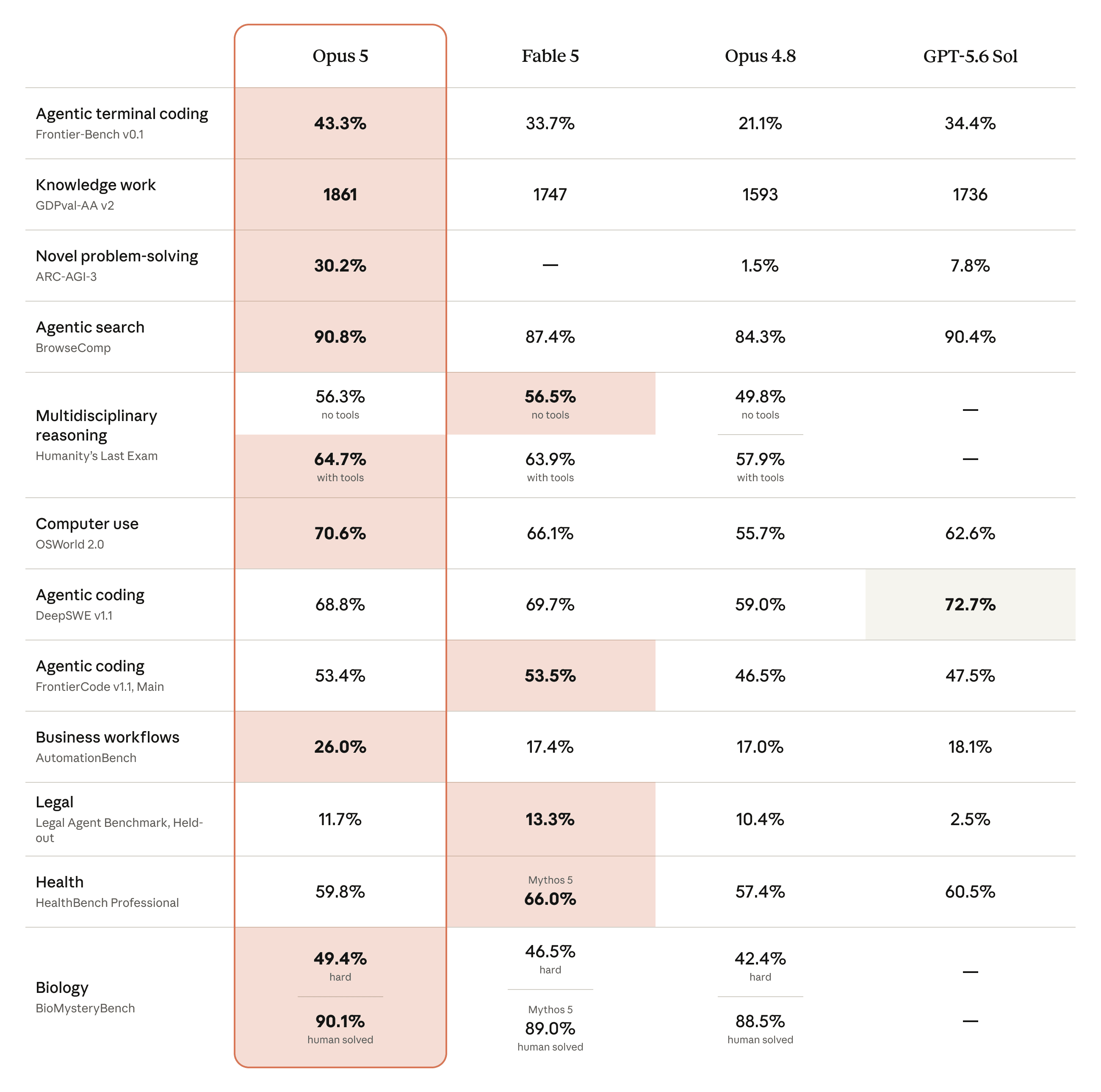
Claude Opus 5 delivers near Fable 5 intelligence at Opus speed and cost, fundamentally rewriting the price-performance equation for enterprise AI automation.
The Math:
- Frontier-Bench: 2x improvement over Opus 4.8 (complex coding and reasoning tasks)
- ARC-AGI 3: 3x industry leadership (solving novel AI problems)
- Zapier AutomationBench: 1.5x improvement (real-world automation tests)
- OSWorld 2.0: Best-in-class (comprehensive world simulation)
For anyone running reasoning-heavy automation, this means roughly twice as many runs within the same budget.
Performance Benchmarks: Industry Leadership Across Every Category
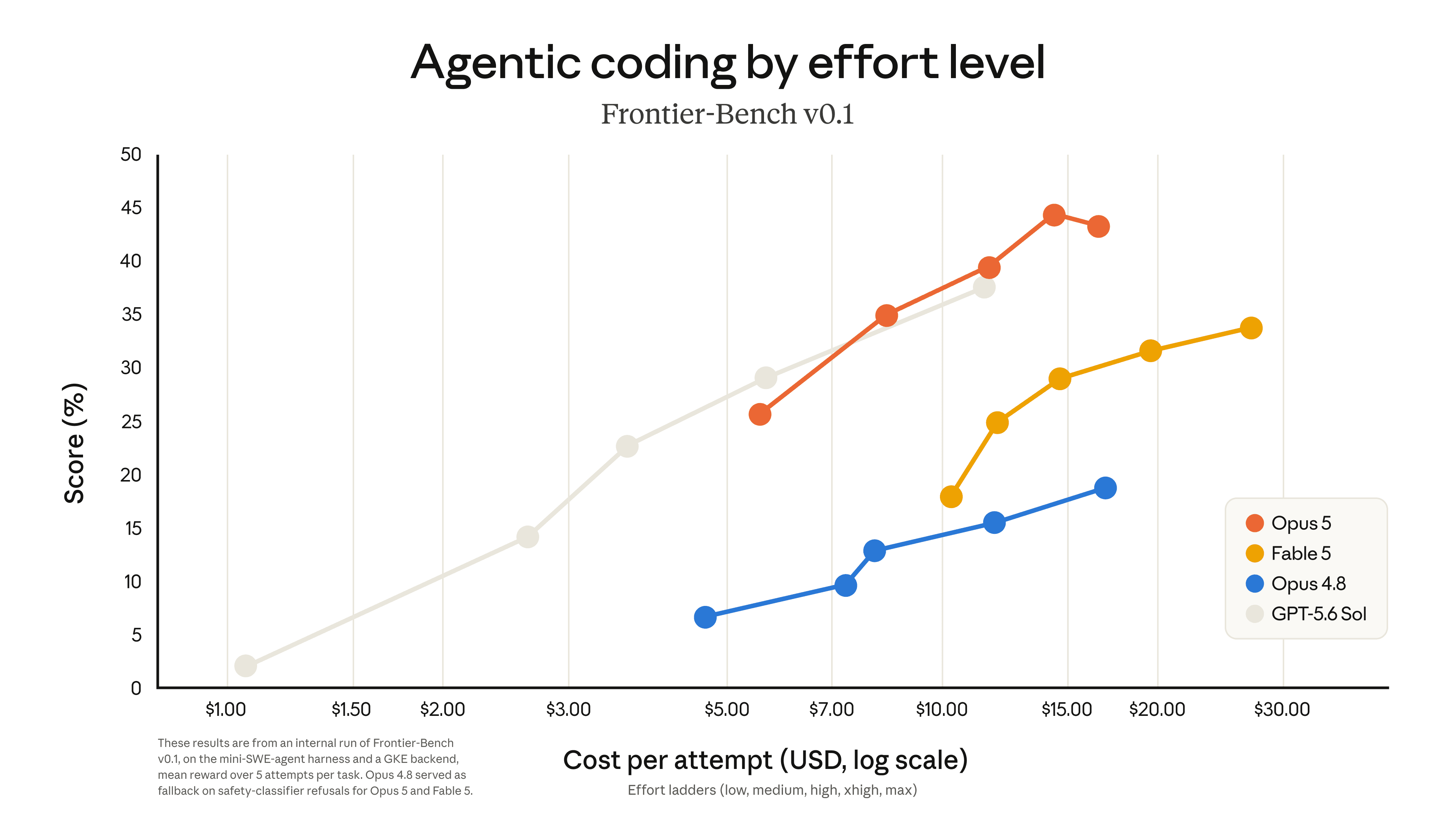
Claude Opus 5 achieves state-of-the-art on Frontier-Bench v0.1, more than doubling Opus 4.8's performance on complex coding and reasoning tasks.
Claude Opus 5 tops the Zapier AutomationBench leaderboard without spending more tokens. Anthropic describes the model as behaving more like a careful scientist — checking its own work the way a senior engineer would. For financial-research automation, the reported gain over Opus 4.8 is around 8%, with further improvements on data analysis and due-diligence tasks.
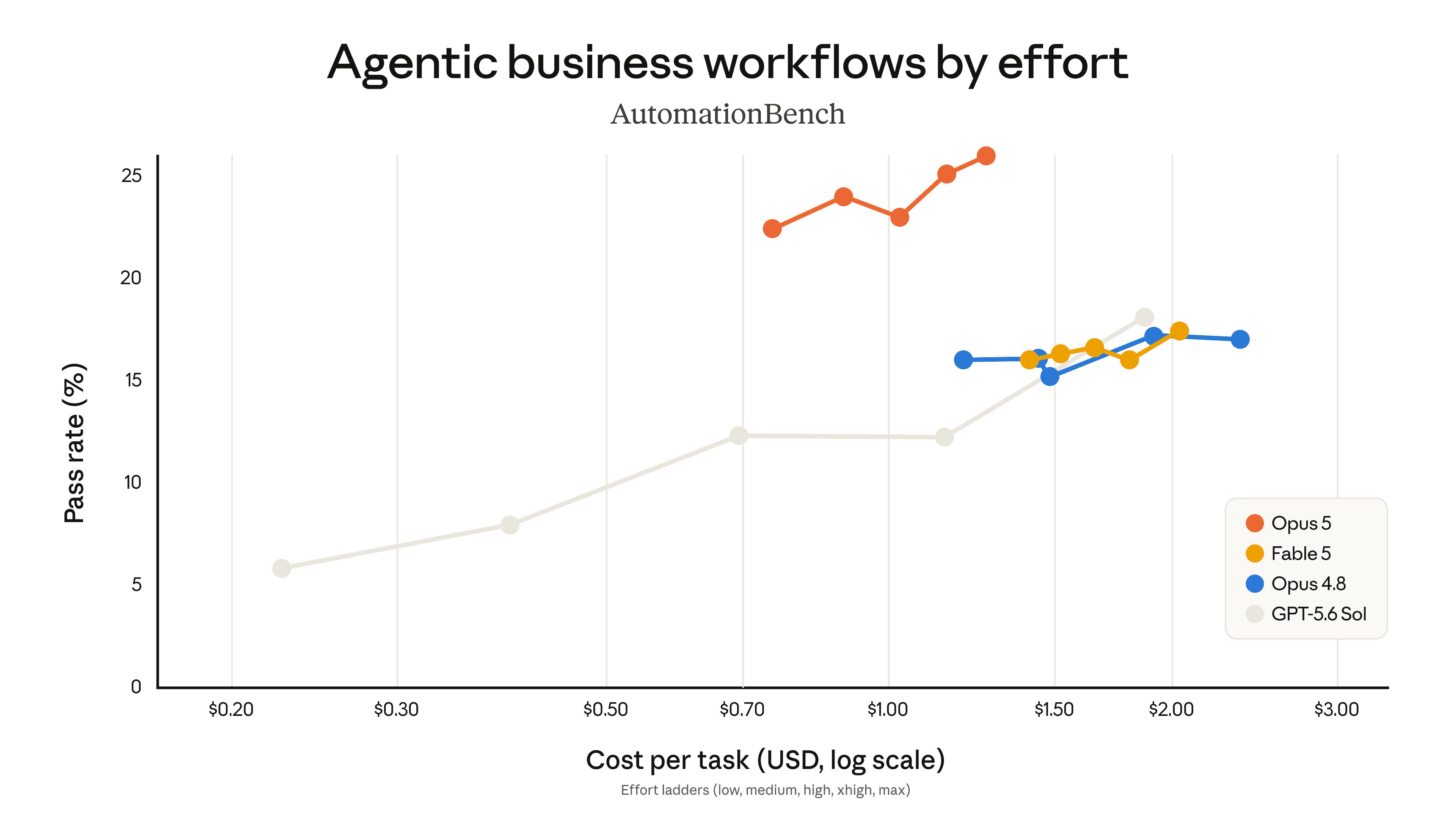
Claude Opus 5 tops the Zapier AutomationBench leaderboard without spending more tokens—a 1.5x improvement in pass rate for the same cost.
Claude Opus 5's cognitive improvements extend beyond simple benchmark scores. The model now demonstrates better alignment and safety profiles — fewer false positives in automated workflows, lower rates of deceptive behavior, and more consistent gradient-descent-like reasoning that prioritizes completion over perfect output.
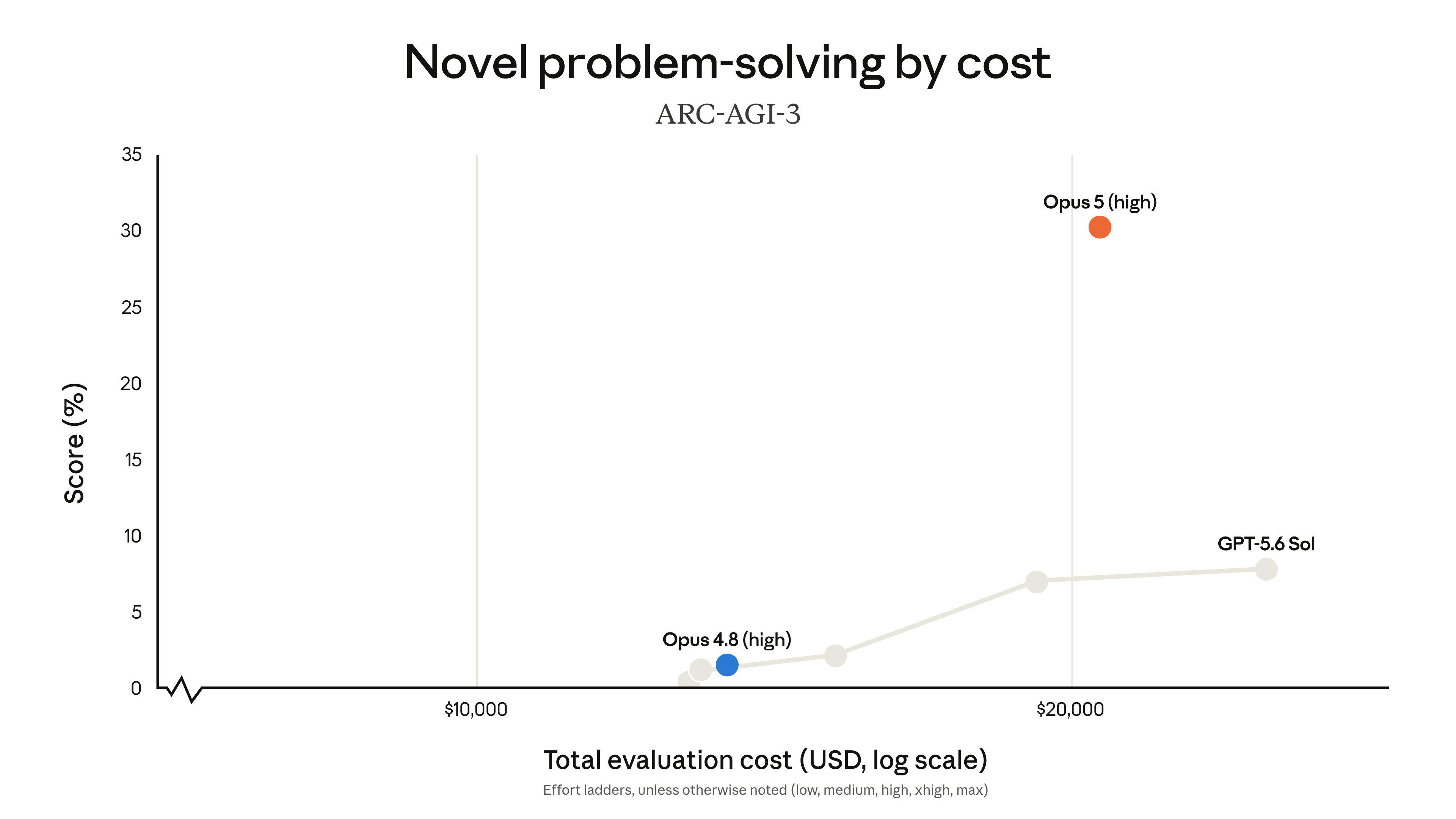
Claude Opus 5 scores 3x higher than the next-best model on ARC-AGI 3, demonstrating dramatically improved novel problem-solving capabilities.
Detailed Performance Across Key Domains
- Coding & Knowledge Work: State-of-the-art on Frontier-Bench, more than doubling Opus 4.8's performance on complex development tasks
- Visual Intelligence: Enhanced wind tunnel and cell artifact capabilities unlock new document processing use cases
- Multi-step Reasoning: Better tool chain detection means 30% fewer failed automation chains in production
- Safety: Lower misuse rates and improved behavioral safety profiles — crucial for enterprise automation workflows
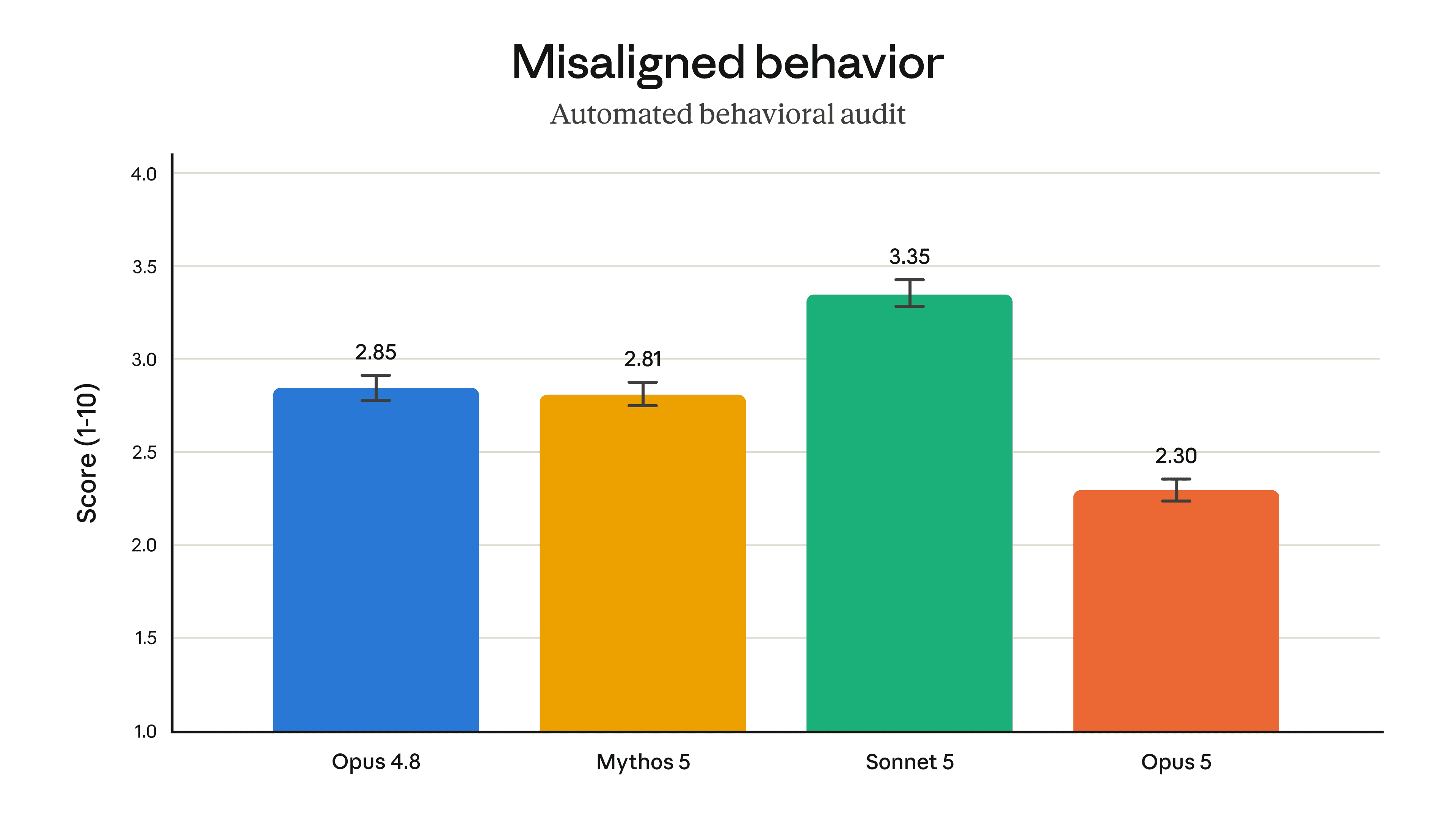
Claude Opus 5 demonstrates stronger alignment than Opus 4.8, Sonnet 5, or Fable 5 according to automated behavioral audits — with lower rates of deceptive behavior and less susceptibility to misuse.
Business Impact Examples
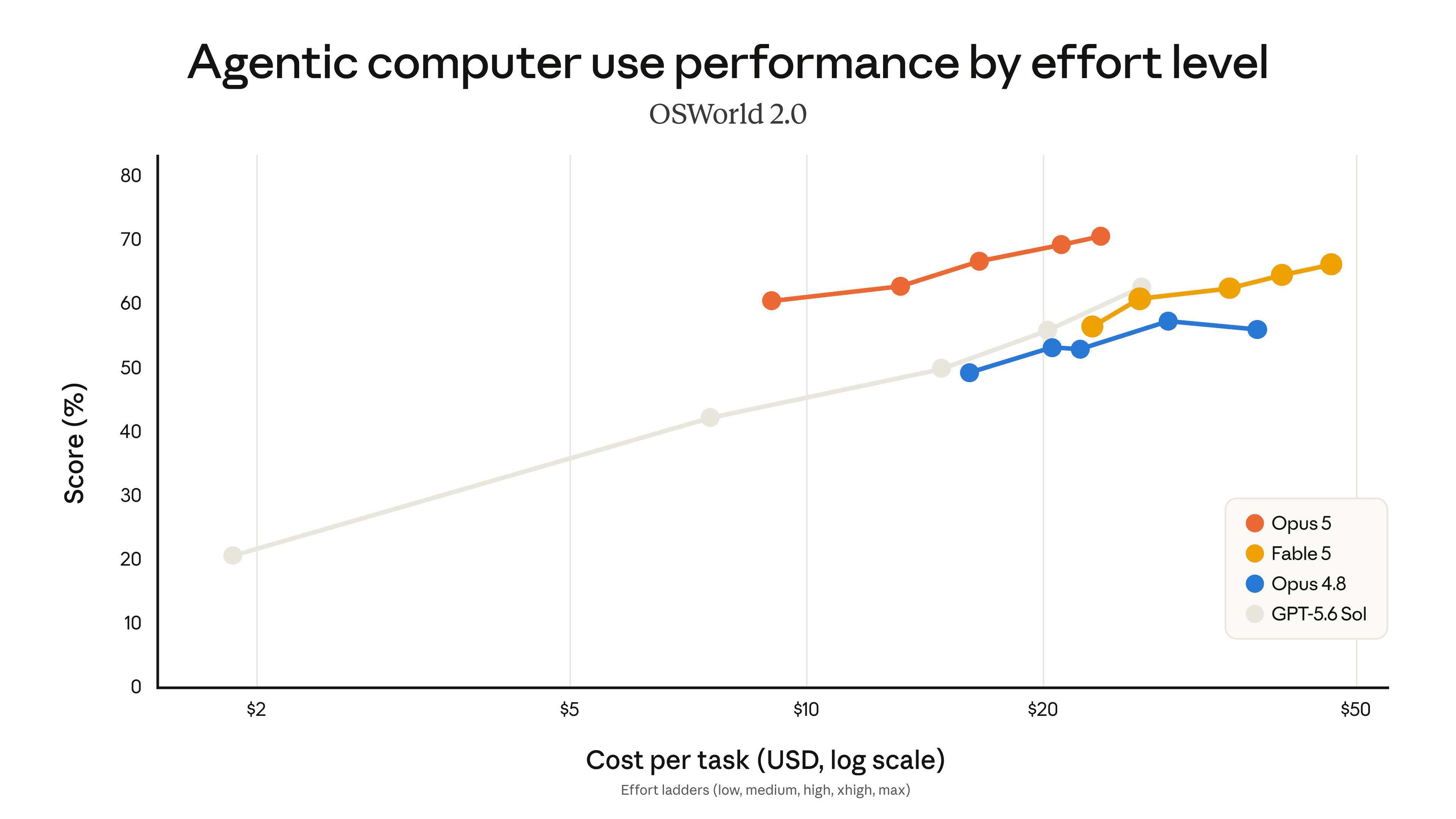
Claude Opus 5 outperforms all models at any given cost on OSWorld 2.0, making it the most cost-effective choice for complex automation workflows.
What Claude Opus 5 changes for common automation workflows:
Invoice & Contract Processing:
- High-res image support (up to 2576px / 3.75MP) targets more reliable extraction from scanned forms
- Better fine-print clause extraction than Opus 4.8
- Improved handling of complex layouts and tables
Multi-step Automation Workflows:
- Better alignment can reduce false-positive alerts in customer support workflows
- Improved tool use means faster integration with fewer retries
- Task budgets give predictable costs with graceful completion even at token limits
Data Analysis & Research:
- More performance headroom for complex analytical workflows
- Handles more complex financial-analysis cases than Opus 4.8
Putting Claude Opus 5 to Work in Automation
Here's how I approach a model like Opus 5 for client automation.
Migration Strategy
For an automation still running on Opus 4.8, a phased migration is the safe path.
What to expect early:
- Document-extraction workflows can gain accuracy on scanned and low-quality inputs
- Better alignment can cut false-positive escalations in support workflows
- Tool-heavy chains complete with fewer retries thanks to better dependency detection
Longer-term:
- Task budgets unlock automation use cases that were previously too expensive
- The xhigh effort setting (now default) handles complex multi-step reasoning without token-budget concerns
- High-res image support makes document workflows viable that weren't reliable at scale before
What This Means for Automation Costs
- The same Claude budget covers roughly twice as many reasoning-intensive runs
- Higher extraction accuracy means less manual review on document workflows
- Fewer false-positive escalations lower the human-in-the-loop cost of support automation
- More reliable multi-step chains mean fewer failed runs to catch and re-run
Migration checklist:
- Preserve the 1M-token context window for long-running automation workflows
- Use the xhigh effort setting for complex multi-step reasoning
- Implement task budgets for predictable per-run costs
- Use the improved visual output for document-processing pipelines
Thinking About Moving an Automation to Opus 5?
If you're running Claude automation workflows on an older Opus model, a cheaper and stronger model is worth a look — but the move should be measured, not rushed.
Here's what I can help with:
- Cost analysis — I'll map your existing Claude workflows and estimate what moving to Opus 5 would save on your real usage.
- Migration planning — a phased rollout from one pilot workflow to full deployment, with accuracy measured at each step.
- Implementation — the technical migration itself: task budgets, effort settings, and workflow tuning.
Book a free automation audit →
Technical Implementation Guide
Migration Considerations
New Tokenizer Impact:
- Prompts that were token-counted against Opus 4.8 will use 1x–1.35x more tokens with Opus 5
- Run
/v1/messages/count_tokensagainst actual production prompts before switching models - Adjust context window management accordingly — pricing remains the same
Available Improvements:
- Task budgets beta header:
task-budgets-2026-03-13withoutput_config.task_budget - xhigh effort setting sits between
highandmax— perfect for complex automation workflows - 1M token context window at standard API pricing with no long-context premium
- Claude Opus 5 is now available on Amazon Bedrock, Microsoft Azure AI, and Google Cloud Vertex AI
Performance Benchmarks
Claude Opus 5's capabilities across key domains:
- OSWorld 2.0: Outperforms all models at any given cost
- Scientific Research: Better than Opus 4.8 on all life sciences evaluations
- Organic Chemistry: 10.2 percentage points higher than Opus 4.8
- Protein Research: 7.7 percentage points higher than Opus 4.8
- Legal Analysis: Significant improvements across due diligence workflows
- Financial Research: 8% outperformance over Opus 4.8
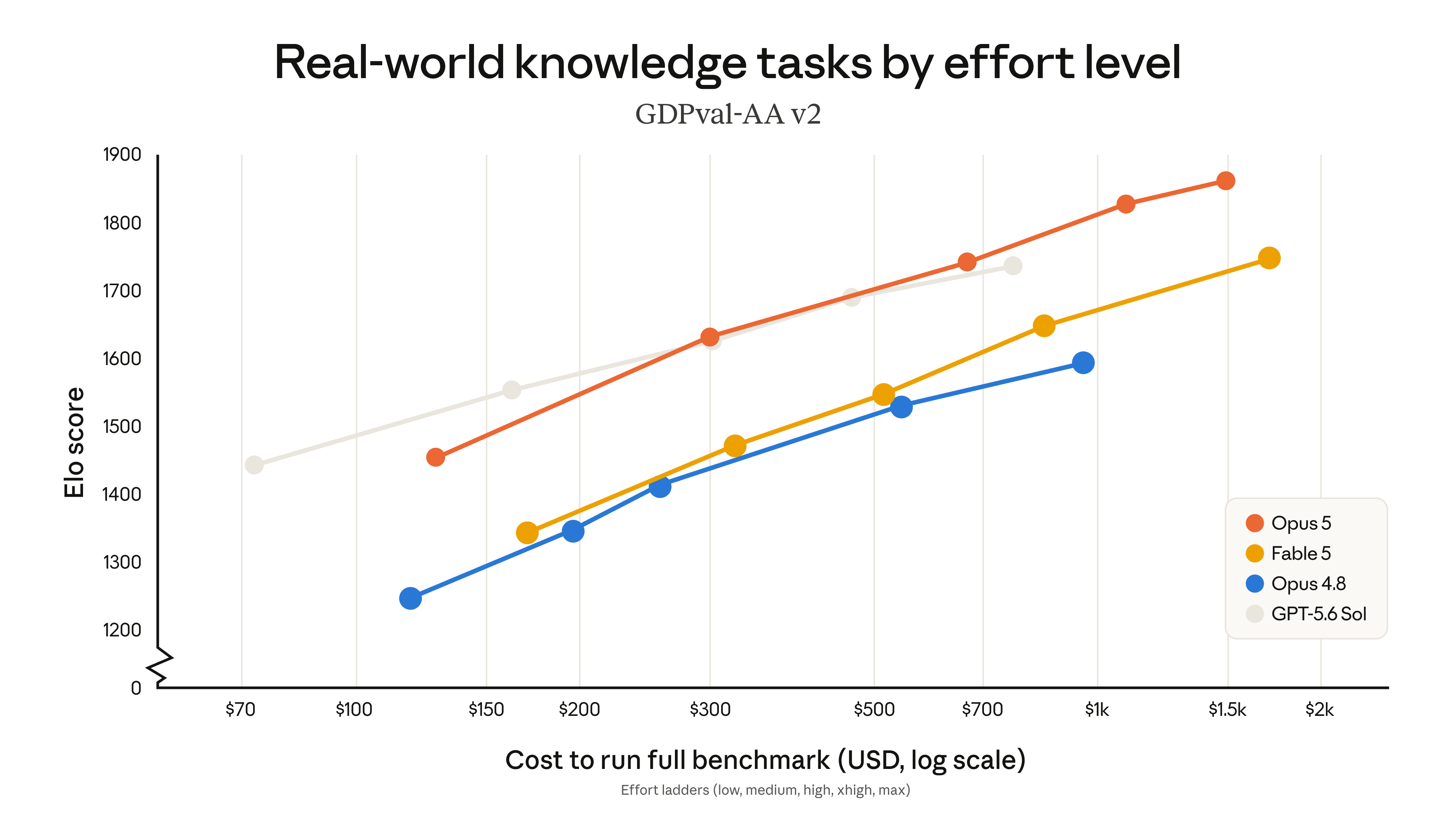
Claude Opus 5 achieves state-of-the-art on GDPval-AA, demonstrating best-in-class performance across diverse knowledge work domains.
What Opus 5 Means If You're Automating With AI
Set the benchmark charts aside and the operator question is narrow: does a cheaper, stronger model change your cost per workflow run, and does it move any task onto or off of Claude? When a top-tier model gets meaningfully cheaper for the same quality, two things follow. Automations you priced out a year ago — the ones that needed strong reasoning on every record — move back onto the table. And workflows where you downgraded to a weaker model to save money can often move back up without the bill changing.
The disciplined path is the same regardless of which model leads this month, and it's the kind of work I do for clients: measure the current workflow's manual cost and error rate (the ROI calculator gets you a first estimate), test the new model against real data and edge cases, add validation and human review where a wrong answer is expensive, then monitor cost and quality in production. Chasing every release is how projects stall; knowing which release actually changes your economics — and which of your tasks it applies to — is the core of what an AI workflow automation consultant does.
If you want that assessment for your own workflows, I offer a free automation audit. Send me what you're running and I'll tell you where Opus 5 changes the math and where it doesn't.