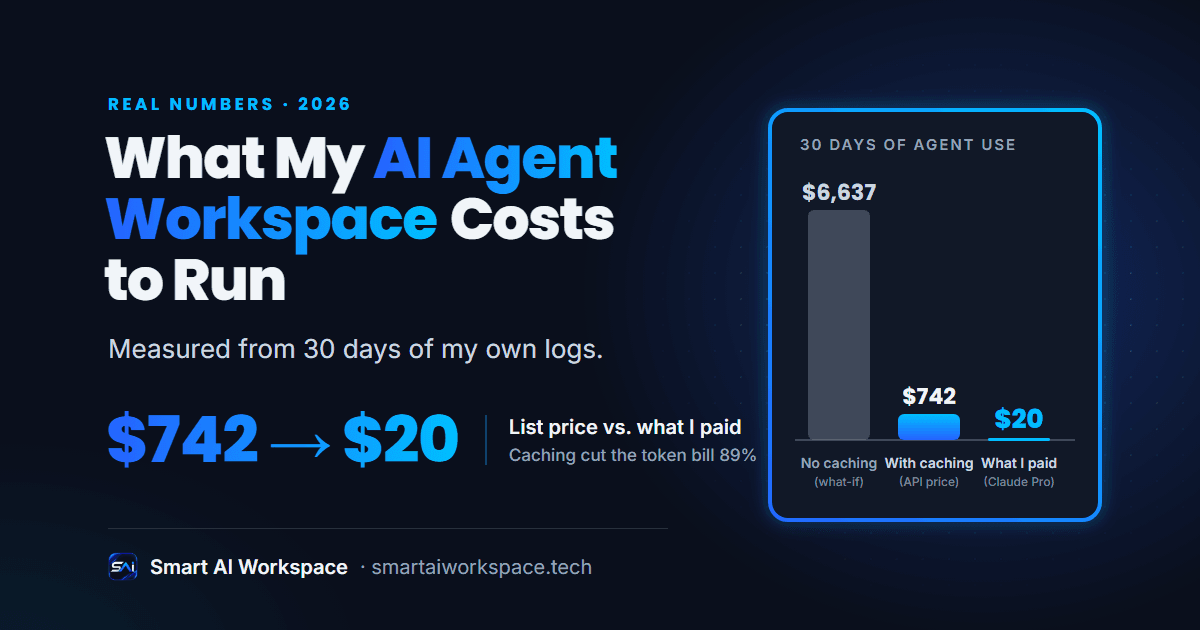
On a $20 a month Claude Pro plan, I ran 30 days of heavy agent use that would cost about $742 at Anthropic's API list prices. Prompt caching cut that token bill by about 89%, and one skill alone saved me an estimated 2 hours a day of manual work. That is what my AI agent workspace costs to run, measured from its own logs.
First, what the data is and is not. It comes from the local session logs Claude Code keeps for my own agent workspace, covering 2026-09-17 to 2026-10-16: 221 sessions, 30 active days and 7,855 model calls, with a median of 26 calls per session. These are interactive sessions, and they include me building and editing the workspace. They are not unattended agents running in production for a client. The $742 is a calculation at list prices, not an invoice.
What Counts as "Cost" Here
I counted tokens from the logs, de-duplicated by message ID, then priced them at Anthropic's published per-million-token rates (page opened 2026-10-16). Five caveats go with every number below:
- "API-equivalent" is not a bill. I pay a flat Claude Pro fee, $20 a month, or $17 a month on annual billing, and Claude Code is included on paid plans. The $742 is what the same usage would cost through the API.
- Cache writes are priced at the 5-minute rate. If any of my cache writes used the 1-hour option, which costs more, the true total is slightly higher.
- The "without caching" figure is a what-if. It assumes the same tokens re-sent at full input price. It shows why caching matters. It is not a bill that could have arrived.
- Building time is in the sessions. Edits to the workspace itself sit alongside the agent runs, so this is not a clean "cost per unattended task".
- I did not measure the cost of any single skill. Every figure is for the whole workspace.
Tokens and Cost by Model
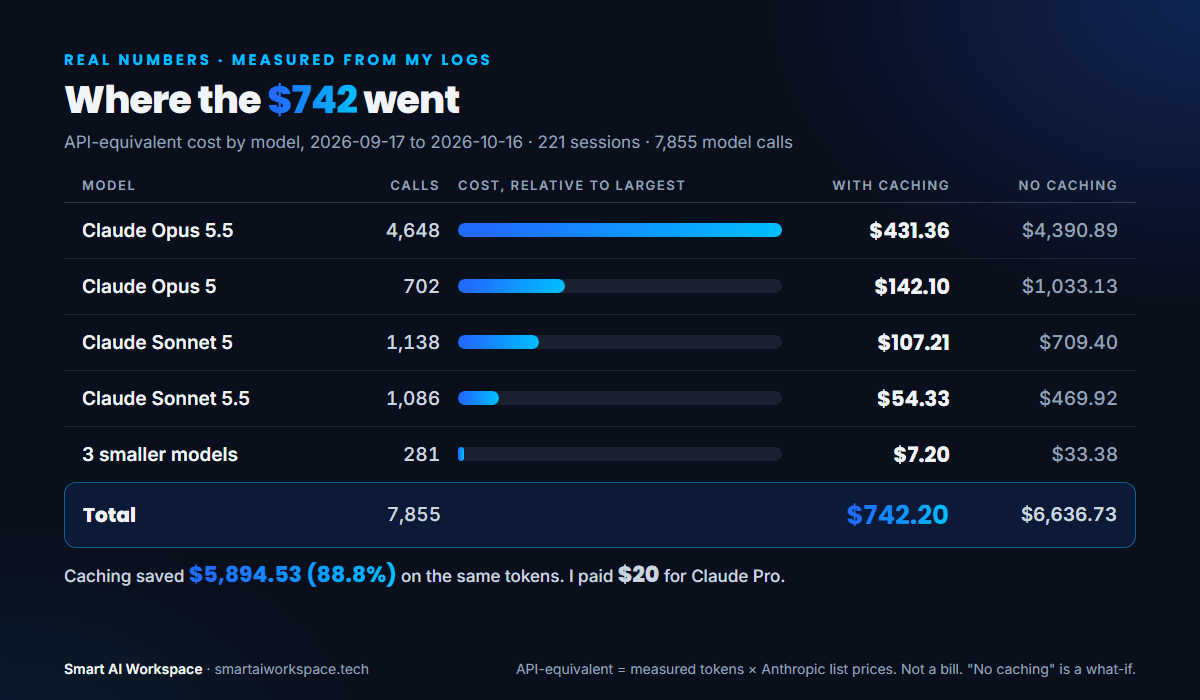
Token counts are in millions. Fresh (uncached) input was just 16,719 tokens across all seven models, so it is left out of the table.
| Model | Calls | Cache reads | Cache writes | Output | API-equivalent cost | Same tokens, no caching |
|---|---|---|---|---|---|---|
| Claude Opus 5.5 | 4,648 | 1,050.3 | 31.4 | 3.21 | $431.36 | $4,390.89 |
| Claude Opus 5 | 702 | 199.1 | 3.9 | 0.72 | $142.10 | $1,033.13 |
| Claude Sonnet 5 | 1,138 | 337.4 | 10.4 | 1.37 | $107.21 | $709.40 |
| Claude Sonnet 5.5 | 1,086 | 221.4 | 10.0 | 0.73 | $54.33 | $469.92 |
| Sonnet 4.6, Haiku 5.5, Haiku 4.5 | 281 | 55.0 | 2.3 | 0.38 | $7.20 | $33.38 |
| Total | 7,855 | 1,863.2 | 58.0 | 6.41 | $742.20 | $6,636.73 |
The two Opus models made 68% of the calls and 77% of the API-equivalent cost. By token type, cache reads were $402.19 of the $742.20, cache writes $235.14 and output $104.81.
What Prompt Caching Did to the Bill
Priced with caching, the month came to $742.20. Priced as if every input token were sent fresh at full price, the same tokens come to $6,636.73. The difference is $5,894.53, or 88.8%.
The reason is how agents work. Every step in an agent loop sends the whole context back to the model, and the average call in my logs carried about 245,000 input tokens. Cache reads were 95.7% to 98.1% of input tokens on each of the four main models (97.0% overall). A cache read is billed at a fraction of normal input: 0.1× the base input price on most models, and 0.05× on Opus 5.5 and Sonnet 5.5, per Anthropic's pricing page. Cache writes cost 1.25× on the 5-minute option, and they were still 32% of my cost. Output tokens, which caching does not touch, were 14%.
Choosing models mattered less than caching did. Opus 5.5 lists at $4 per million input tokens against $2 for Sonnet 5, a 2× gap. Caching moved the bill by about 9×. If you run agents on the API and you are not looking at your cache hit rate, that is the number to look at first. I wrote up the mechanics, and the mistakes that silently turn it off, in how I cut a client's API bill with prompt caching.
Flat Plan vs API-Equivalent: What I Actually Paid
I paid $20, or $17 on annual billing. Against $742.20 that is about 2.7%. This only works because Claude Pro is a flat fee for interactive use with usage limits, and all of this ran inside those limits.
Unattended agents do not get that deal. An agent running on a server calls the API and is billed at the API rate, so for that case the right budget figure is the API-equivalent one, from a short pilot with logging on. The $742 is a guide to the order of magnitude for heavy, long-context agent work, and not a quote for any client build. For the typical small-business workflow I have seen API and tool subscriptions of $100 to $600 a month, as I set out in how much AI automation costs.
How Much Time Did It Save?
The cost side is measured. The time side is half measured. The run count comes from the logs, and the baseline is my own estimate.
The skill is upwork-job-screener, which screens Upwork jobs for me. It ran 368 times across 27 of the 30 days, about 12 a day averaged over the month and about 14 on the days it ran. Screening one job by hand takes me about 10 minutes. I have not timed it with a stopwatch.
| Step | Value |
|---|---|
| Runs in 30 days (measured) | 368 |
| Manual time per job (my estimate) | about 10 minutes |
| 368 × 10 minutes | 3,680 minutes = 61.3 hours |
| Per day over 30 days | about 2.0 hours |
| If the true baseline were 5 minutes | about 1.0 hour a day |
Two cautions. First, this is one skill, and I am not claiming savings from any other. Second, the $24.74 a day covers the whole workspace, not the screener, so the cost and the saving are not a matched pair. Separately, my sessions added up to about 59 hours over the month. That is time spent in sessions, not time saved.
How This Compares With the Published Benchmarks
Most cost guides for AI agents are built on assumptions. Two recent ones are worth reading next to measured data, with their limits stated.
EY (Unlocking agentic value, 1 June 2026) gives an example of a customer service assistant where a chat that once cost $0.04 can become a $1.20 orchestration once it involves tool retrieval, planning and subagents. That is 30 times higher. EY names no data source for those figures, so read them as an illustration. It also says agentic workflows can use hundreds of thousands of tokens in a single session, against hundreds for a traditional chat. My average session processed roughly 8.7 million input tokens (1.92 billion across 221 sessions), nearly all of it cache reads. EY does not say how it counts tokens, so the two are not directly comparable, but it supports the point: a session-level token count means little until you know how much of it was cached. EY also cites a Gartner projection that more than 40% of agentic AI projects will be canceled by the end of 2027, with escalating costs one of three reasons given. I could not open the Gartner source myself, so treat that as EY's citation.
Digital Applied (AI Agent Build & Run Cost Index 2026, July 2026) puts a simple task agent at about $7,200 to build and $800 a month to run, a RAG-workflow agent at about $18,000 and $2,700 a month, and a multi-agent system at about $36,000 and $6,250 a month. Its largest run cost in every tier is senior oversight, not tokens. The page says plainly that the bands are "our stated-assumption model, not an industry survey". Its simple tier assumes 10,000 requests a month at 1,200 input and 400 output tokens each. That is about 12 million input tokens a month, against the 1.9 billion in my workspace, which is a reminder that interactive agent work re-sends far more context. It also priced Sonnet 5 as introductory $2/$10 per million tokens rising to $3/$15 after August 31. Anthropic's pricing page now says that increase will not occur and $2/$10 is the standard price, which is how quickly assumption-based guides date.
What I can add is a measurement, with honest limits. It is one person, one month and one workspace, and it is not client production. It cannot tell you what oversight costs, because I did not measure my own time. It does show that token cost is not a fixed fraction of anything: caching alone swung it by 9×.
If You Are Budgeting an AI Agent: Decision Rules
- Decide how it is billed before you estimate anything. Interactive work on a flat plan and an unattended agent on the API are different budgets.
- Estimate from a pilot, not a chart. Run the real task for a week with usage logging on and price the tokens, rather than multiplying a guessed request count by a guessed token count.
- Check the cache read share. If an agent re-sends long context and the share is low, you are paying the no-caching price, and that is the most fixable line.
- Budget the people time separately. The vendor guide above puts oversight ahead of tokens, and my data cannot say otherwise.
- Put the saving in the same units as the cost. Count runs, multiply by a baseline you can defend, and say it is an estimate. Then you can see if the number survives a halving of the baseline. For more on the method, see how to measure AI automation ROI.
How Smart AI Workspace Approaches This
I run Smart AI Workspace as a founder-led practice, and I use this workspace daily, so I have a first-hand sense of what agent work costs. On client work, model and API costs run on your own accounts with no markup, and I log usage during a pilot so the budget comes from your numbers. The pricing page explains how I price builds, and the services page covers what I build. If you want a cost estimate for a specific workflow, contact me, or check my verified work history on my Upwork profile.
Sources: Anthropic API pricing, opened 2026-10-16 · Claude plans and pricing, opened 2026-10-16 · EY: Unlocking agentic value (2026-06-01) · Digital Applied: AI Agent Build & Run Cost Index 2026 · Token counts: my own Claude Code session logs, 2026-09-17 to 2026-10-16