A load tender lands in a shared inbox. Someone retypes the lane, rate, and pickup window into the TMS, checks the carrier, sends the rate con, then spends two days answering "where's my truck?" C.H. Robinson says 5,200+ customers now get loads accepted in under 90 seconds instead of waiting up to four hours in an email queue, because AI agents do that work. The same inbox is where fraud now arrives: Highway's Q2 2026 Freight Fraud Index classified half of all fraud vectors as communication-based (compromised inboxes, spoofed emails, impersonation calls). For a brokerage, 3PL, or small fleet, the manual work and the risk sit in one place. This post is the order I'd automate it in, and why.
AI Automation for Logistics: The Short Answer
Quick answer: automate the high-volume, read-only work first, then the documents that feed everything else, and keep a person on every decision that moves money, approves a carrier, or sets a price:
- One source of truth in your TMS (a prerequisite, not a tech project)
- Shipment status updates and check calls
- Document and email intake
- Carrier vetting and fraud screening, with a human approving
- Freight invoice audit
- Exception management
- Pricing, routing, and forecasting, human-reviewed
This is the freight back office, not warehouse robotics. The rest of this post is why that order, where the US and Canadian compliance lines sit, and what a build costs.
Where Logistics Companies Actually Stand With AI in 2026
Almost everyone is testing AI. Few have it in production. The 2026 MHI Annual Industry Report (with Deloitte, about 500 supply chain leaders) found 41% of companies now use AI, up from 30% a year earlier. Truckstop and Bloomberg Intelligence found 48% of freight brokers deploying AI or machine-learning productivity tools.
Depth is thinner. Descartes' 10th Annual Transportation Management Study (600 transportation decision-makers, September 2026) found only 19% of shippers and 15% of logistics service providers use AI at scale. Gartner expects 60% of enterprises using supply chain software to have adopted agentic AI features by 2030, up from 5% in 2025, and found 83% of supply chain organizations getting there incrementally, one use case at a time.
| Where Logistics AI Stands | Figure | Source |
|---|---|---|
| Supply chain companies using AI | 41% (up from 30%) | MHI / Deloitte, 2026 |
| Freight brokers deploying AI or ML productivity tools | 48% | Truckstop / Bloomberg Intelligence, 2026 |
| Shippers using AI at scale | 19% | Descartes, 2026 |
| Logistics service providers using AI at scale | 15% | Descartes, 2026 |
| LSPs naming data quality as the top barrier to scaling AI | 45% | Descartes, 2026 |
| Supply chain software users with agentic AI features | 5% (2025) to 60% (2030 forecast) | Gartner, 2026 |
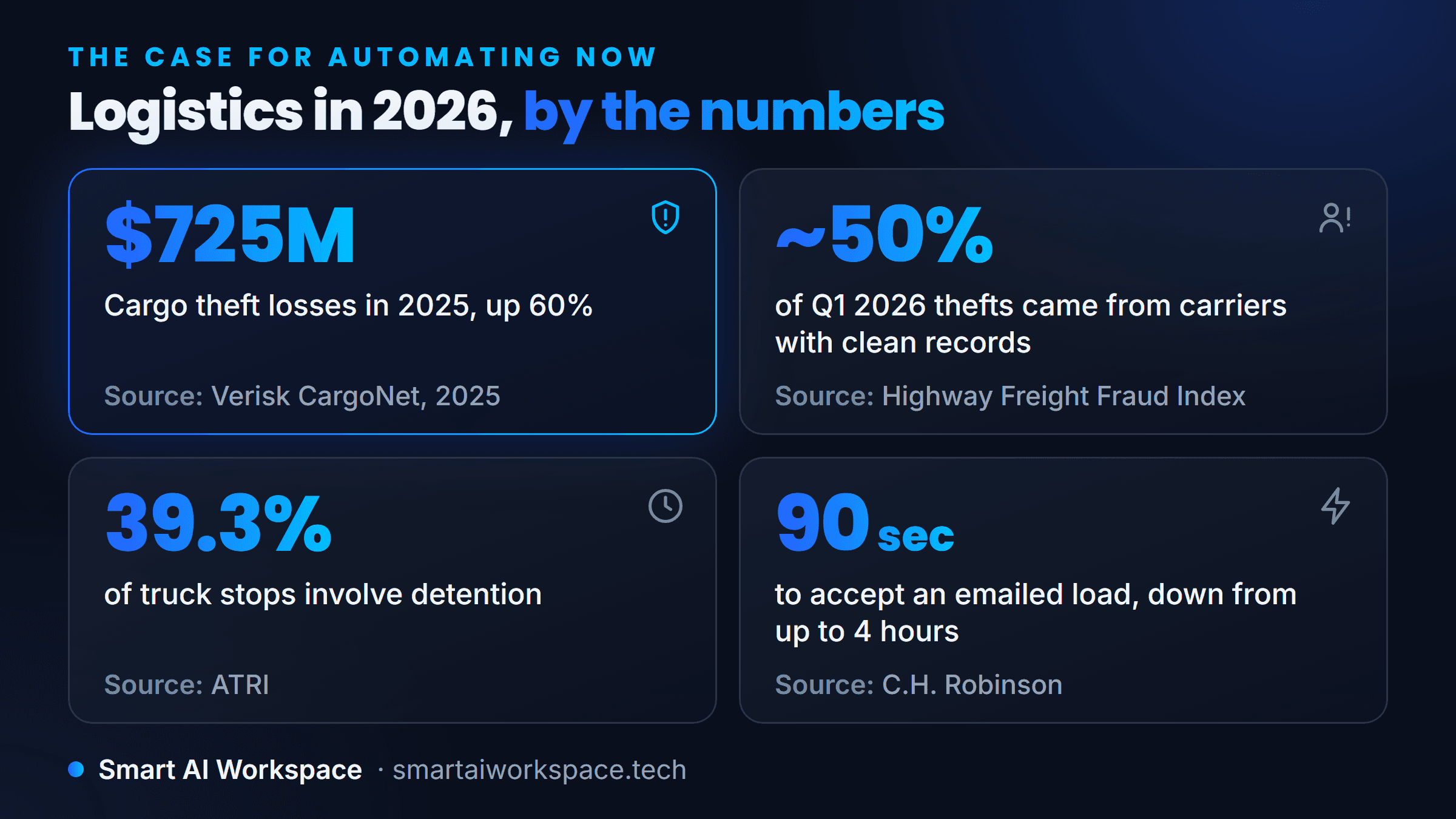
Adoption numbers describe intent. What the manual work costs in the meantime shows up in theft losses, unpaid detention, and loads sitting in an inbox:
What to Automate First in Logistics: The Order, and Why
Each rung reads data the previous one created or reuses its connections, so the order matters more than the tools.
| # | Build | Why this rung | Payback |
|---|---|---|---|
| 0 | One source of truth in your TMS | Automating a messy TMS automates the mess | Prerequisite |
| 1 | Status updates + check calls | Highest-frequency touch, read-only, APIs already exist | 2–6 weeks |
| 2 | Document + email intake | Top generative AI use in transportation; feeds every later rung | 1–2 months |
| 3 | Carrier vetting + fraud screening, human approves | Biggest single-event loss; needs Rung 0 records and Rung 2 intake | Loss avoidance |
| 4 | Freight invoice audit | Reuses Rung 2's data; touches money, so disputes go to a person | 1–3 months |
| 5 | Exception management | Needs Rung 1 status data and customer-facing judgment | 2–4 months |
| 6 | Pricing, routing, forecasting, human-reviewed | Sets margin, touches hours-of-service limits, needs history | Ongoing |
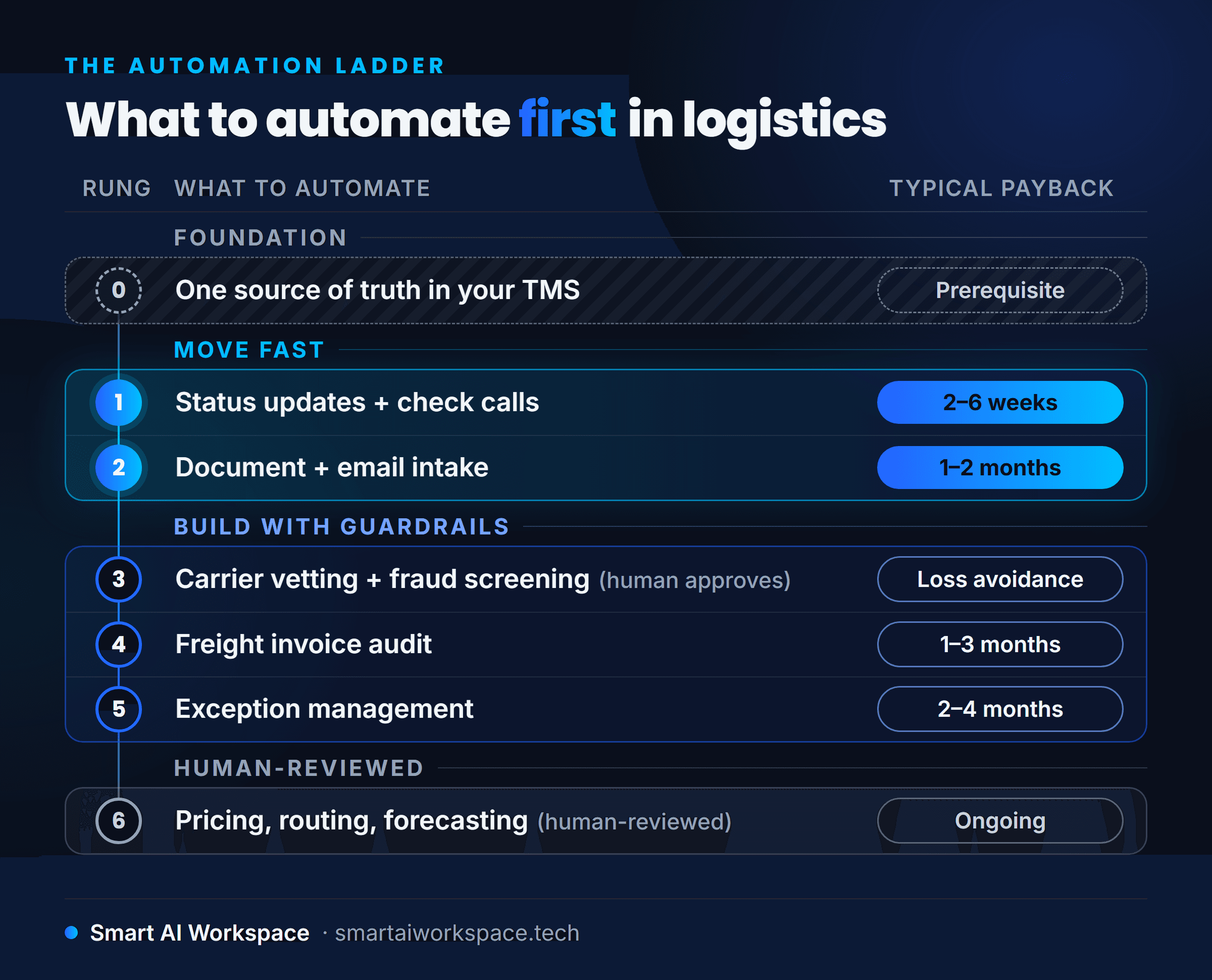
Payback windows are typical of my builds at the prices below, counted from go-live. They're my delivery estimates, not figures from a study.
Rungs 1, 2, and 4 share one integration surface, so each costs less than the last, and Rung 3 plugs a vetting tool into it. Vetting would be Rung 1 if urgency decided the order, but screening is only as good as the carrier records (Rung 0) and emails (Rung 2) it checks. Rung 6 comes last because getting it wrong automates a margin problem. Rungs 1, 2, and 5 are the tracking, document, and exception workflows on my logistics automation page.
- Brokers and 3PLs: every rung applies, and Rung 3 is the urgent one.
- Carriers and small fleets: Rung 3 flips to verifying brokers and shippers, and Rung 4 becomes billing detention with ELD timestamps as proof.
- Shippers with in-house logistics: Rungs 1, 2, and 4 are the core.
Step 0: Get One Source of Truth in Your TMS
Most logistics automation projects that stall skipped this step. In Descartes' 2026 study, data quality was the top barrier to scaling AI for 45% of logistics service providers and 33% of shippers, with integration complexity close behind (38% and 39%).
The mess is familiar: the rate con in someone's inbox, the POD in a text thread, three versions of the same customer in the TMS. Automate on top of that and an agent updates the wrong load or pays against a rate renegotiated by phone. The fix is one load record carrying the customer, carrier identifiers, rate con, BOL, POD, accessorials, and carrier invoice. It's days to a few weeks of cleanup, not a new TMS.
Rungs 1 and 2: Automating Check Calls, Status Updates, and Freight Documents
Status updates are the safest first build because the agent only reads and reports. Samsara and Motive publish location and hours-of-service APIs, and project44, FourKites, Descartes MacroPoint, and Trucker Tools expose tracking by API or file feed. The agent pulls the ping, compares the ETA to the appointment, updates the TMS, and messages the customer. Loads with no signal, or running late, go to a person. That handoff is what makes it trustworthy.
Document and email intake is where the hours are. Data entry is the most common generative AI use in transportation management, at 41% in Descartes' 2025 survey of 616 shippers and LSPs. In a Deep Analysis survey sponsored by Hyperscience, 82% of 300 transportation and logistics enterprises said manual document processing has a heavy to extreme impact on efficiency, and 51% cited high data-entry error rates. C.H. Robinson's AI agents have performed more than 3 million shipping tasks. That's a 37-million-shipment-a-year operation, not a small-broker benchmark, but the pattern holds at any size.
The safe pattern is extract, validate, flag: pull the load number, parties, dates, weights, rate, accessorials, and signatures from the email or scan, check them against the load record, and flag mismatches (a rate that doesn't match the rate con, an unsigned POD) instead of posting blind. It's the same pattern I used for automating invoice intake from Gmail with Claude.
Not sure which logistics workflow to automate first?
I'll audit your TMS, inbox, and tracking stack and tell you which build has the clearest payback. Free, no obligation.
Rung 3: Using AI to Screen Carriers for Double Brokering and Identity Fraud
Fraud is the 2026 freight story. Verisk CargoNet counted 2,646 cargo thefts in the US and Canada in 2025, up 18%, with estimated losses of about $725 million, up 60%, and an average loss of $273,990. In Canada, Équité Association data shows truck thefts rose from 591 to 984 over the first three quarters of 2025 versus 2024, while the cargo recovery rate fell from 13% to 9%. And per the Transportation Intermediaries Association's April 2025 report, 22% of brokers lost more than $200,000 to fraud in six months.
A one-time onboarding check no longer catches it. Highway's Q1 2026 Freight Fraud Index found carriers with legitimate MC numbers and clean histories caused roughly 50% of theft incidents, and ownership-change fraud was up 169.6%. In Q2, Highway blocked 784,201 fraudulent emails, up 58.3%.
That puts fraud in the inbox Rung 2 already reads. A workflow can run identity, authority, insurance, and ownership-change checks on every tender through Highway, Carrier Assure, or RMIS, and flag an email domain or phone number that doesn't match the carrier record before the rate con goes out. FMCSA's Motus registration system (live since May 19, 2026) adds identity proofing, but MC numbers weren't retired at launch, so vetting still handles them.
The agent screens. A person approves or rejects the carrier.
Rungs 4 to 6: Freight Invoice Audit, Exception Management, and Why Pricing Comes Last
Rung 4, freight invoice audit, reuses Rung 2's data: the agent lines up the rate con, carrier invoice, accessorials, and POD before you pay or bill. Clean matches move on. Mismatches go to a person. For carriers it runs in reverse, billing detention with ELD timestamps as proof. ATRI found 94.5% of fleets charge detention fees but get paid on fewer than half of those invoices.
Rung 5, exception management, is where the phone calls live. Drivers are detained at 39.3% of stops, costing $3.6 billion in direct expenses and $11.5 billion in lost productivity in 2023 (ATRI). The agent watches status against appointments, runs the detention clock, drafts the customer notice, and suggests a reschedule or reroute. Messages start as draft-for-approval, because ETA promises are judgment calls.
Rung 6, pricing, routing, and forecasting, comes last. Quote-to-book agents work at C.H. Robinson, but with pricing history from 37 million shipments a year behind them. A smaller broker needs the clean history Rungs 0 through 5 create first. And a route that ignores hours-of-service limits is a compliance problem, so HOS stays a hard constraint and a dispatcher approves the plan.
Tools and Integrations: TMS, ELD, Visibility, Load Boards, and EDI
Easy (documented APIs or native platforms):
- TMS: Rose Rocket has an open API and webhooks. Revenova runs natively on Salesforce. McLeod offers REST APIs into LoadMaster and PowerBroker through a certified-partner program.
- ELD and visibility: Samsara, Motive, project44, FourKites, and Descartes MacroPoint publish APIs. Trucker Tools takes load data by API or SFTP.
- Load boards and vetting: DAT has APIs through a developer portal (account required), RMIS by Truckstop has onboarding and monitoring APIs, and Highway says it integrates with 30+ TMS platforms.
Needs a specialist:
- EDI: many shippers still require X12 (204 tenders, 990 responses, 214 status, 210 invoices) through a VAN or EDI provider, not just REST.
- MercuryGate and Turvo: MercuryGate (owned by Körber since September 2024) is enterprise-grade and highly configurable, and Turvo works through partner integrations such as Trucker Tools. Both take longer to scope.
- Customs: automate document prep and validation, not the ACE or ACI filing itself.
On the engine: webhooks, API polling, and EDI translation are commodity plumbing, and which tool runs them barely matters. The value is the reasoning layer: reading a messy rate con, deciding whether a late ping needs a call, noticing a carrier's email domain changed last week. That's what I build as a Claude agent on top of the plumbing (more in specialized agents vs. chatbots).
The Compliance Section Most Vendors Skip (US and Canada)
Broker records (49 CFR 371.3). US brokers must keep a record of each transaction (consignor, carrier and its registration number, BOL or freight bill number, compensation, charges collected, date the carrier was paid) for three years, open to review by each party. FMCSA proposed in November 2024 to require electronic records delivered within 48 hours of a request, and sent a supplemental proposal to the White House for review on August 27, 2026. It isn't final, but if Rungs 2 and 4 write charges and payments to the TMS on every load, a 48-hour request becomes a report, not a scramble.
ELD data (49 CFR 390.36). A carrier can't use ELD data to harass a driver into violating hours-of-service rules or driving while ill or fatigued. An agent that pushes a driver to "make up time" can cross that line. Canada has enforced its ELD mandate since January 2023, and devices must be third-party certified.
Customs timing. CBP needs truck cargo data through an approved EDI system no later than one hour before arrival (30 minutes under FAST), and CBSA's ACI eManifest has the same one-hour rule for highway cargo. AI prepares and validates manifest data from the BOL and packing list. The licensed provider files.
Canada and privacy. There's no federal broker license in Canada. Quebec requires transport intermediaries to register with the Commission des transports du Québec, so check your province. Driver location and contact data are personal information: California's CCPA employee and B2B exemptions expired in 2023, and Quebec's Law 25 requires a privacy impact assessment and a written agreement before that data leaves the province, which matters for any US-hosted AI tool.
That's why Rungs 1 and 2 move fast (they read and record) and Rung 6 goes carefully (it decides).
What a Logistics Automation Build Costs in 2026
- Single automated workflow (status updates and check calls, or rate-con and POD intake, end to end): $5,000–$12,000
- Connected build (status + document intake + carrier checks + invoice matching): $15,000–$35,000
- Ongoing retainer (monitoring, tuning, new workflows): $1,500–$6,000/month
- Audit and scoping: free
In my builds, status automation typically pays back in 2–6 weeks and document intake in 1–2 months from go-live, because both remove work that scales with load count. Those are delivery estimates, not a benchmark. Vetting pays back as a theft that doesn't happen: one at CargoNet's 2025 average ($273,990) is more than 20 times the top of the single-workflow range, though insurance and liability splits vary. Run your own numbers through the ROI calculator, and see how much AI automation costs and how to measure AI automation ROI.
How Smart AI Workspace Approaches Logistics Automation
I'm Tariq Osmani, founder of Smart AI Workspace. I build logistics automation as a founder-led engagement: the person scoping your build is the person writing the agent logic.
It starts with a free audit of your TMS, inbox, and tracking stack to find where check calls, rekeying, and invoice matching eat the most hours. I tell you which workflow pays back first (usually status updates), and you get a fixed-scope proposal before any build starts.
A Claude agent is the reasoning core (reading rate cons, deciding which late load needs a call, flagging changed carrier details) on standard webhook, API, and EDI plumbing. Customer messages run draft-for-approval until accuracy justifies auto-send. Carrier approvals and pricing always stay with a person. Your TMS and accounts stay in your name, and you get the workflows, the prompts, and a runbook. See AI automation for logistics for the workflows I build, or custom AI agents and AI workflow automation.
Get Your Logistics Workflow Scoped
If your team spends the day on check calls, rekeying tenders, or chasing detention, that's a scopeable build with a measurable payback. Contact me for a free audit. I'll tell you which workflow to automate first and what it will cost. See AI automation for logistics, what I build, how I price, or check verified work history on my Upwork profile.
Sources: Verisk CargoNet: 2025 Theft Trends · Highway: Q1 2026 Freight Fraud Index · Highway: Q2 2026 Freight Fraud Index · TIA: State of Fraud in the Industry (April 2025) · ATRI: Truck Driver Detention Impacts (2024) · Descartes: 10th Annual Transportation Management Study (2026) · Supply Chain Xchange: Descartes/SAPIO Generative AI Survey (2025) · DC Velocity: 2026 MHI Annual Industry Report · Gartner: Agentic AI in SCM Software Forecast (April 2026) · Gartner: AI and Supply Chain Operating Models (May 2026) · Truckstop / Bloomberg Intelligence: Freight Broker Outlook 1H26 · C.H. Robinson: AI Performs Over 3 Million Shipping Tasks (2025) · FreightWaves: The Silent Profit Killer in Transportation Logistics (sponsored by Hyperscience) · Insurance Business Canada: Équité Association Cargo Theft Data · TD Cowen Carrier Survey via DC Velocity · eCFR: 49 CFR 371.3 · eCFR: 49 CFR 390.36 · eCFR: 19 CFR 123.92 · FreightWaves: Broker Transparency Proposal Heads to the White House (August 2026) · FMCSA: Motus Registration System · Transport Canada: ELD Q&A · CBSA: eManifest Highway Requirements