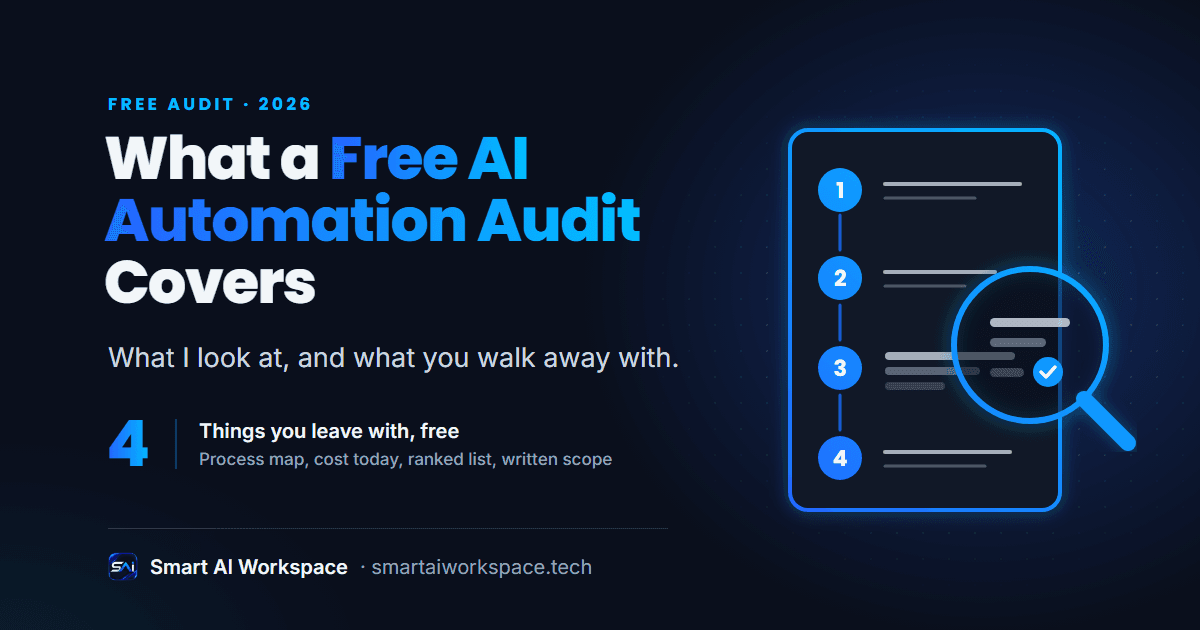
A free AI automation audit is a short piece of work where someone maps one of your processes, puts a number on what it costs you today, and tells you whether automation is the right fix at all. Mine ends with a written scope, timeline and price before anything is built. If the numbers say a build can't pay for itself, I say so then, before you have spent anything.
The audit is my own offer, so I have an obvious interest in you booking it. I'll cover that catch below. I work with businesses across the US and Canada, remotely.
The Catch, Stated Plainly
A free audit is not charity. It is how I start work with new clients, and every engagement I run begins with one. If you book it, I hope you hire me afterward.
It is still useful with no obligation, because the output does not depend on you hiring me. You keep a short written summary (the process map, what it costs you today, and the ranked candidates) whether or not you hire me. Both the number and the honest read on whether automation is the right tool are worth having whoever builds it.
What a free audit includes depends on who is offering it, so ask any provider what you get in writing. The 12 questions in my hiring guide work on any vendor, me included, and the buyer's evaluation guide covers how to compare agency types.
What I Look At, Step by Step
1. The process, from trigger to result
I map what happens from the moment something starts the work to the moment it is done: who acts, in which systems, where the path changes, and what happens when the data is incomplete. The exceptions matter most. They are the steps nobody wrote down, and they are where automations break.
2. What it costs you today
This is where the audit earns its keep. I put a number on the manual version in your figures, not mine: hours spent, errors and what they cost, and revenue missed while the process is slow. If you want a rough starting point before we talk, the ROI calculator takes the same inputs.
3. Is automation the right tool at all?
Some processes need an AI agent because the input is messy and the next step takes judgment. Some need a plain rule-based workflow. Some need neither. I check which one you have before anything gets priced.
4. Which candidate goes first
If you have several candidates, I rank them by what each one costs you today, so the first build has the clearest payback. I score each on four questions: volume (how often it runs), how little judgement it needs, the blast radius if it goes wrong, and data readiness. I used the same rule on a set of agency workflows in AI automation for marketing agencies. The scores are my judgement, not measurements, and the point is the order they produce.
5. A written scope, timeline and price
The audit ends with a written proposal before any build starts. My fee is value-based, a fraction of the first-year value the automation creates, so it comes straight out of the numbers in step 2. Model and API costs run on your own accounts with no markup. The ranges I have published are $5,000 to $12,000 for a single workflow, $15,000 to $35,000 for a connected build and $1,500 to $6,000 a month for a retainer, as reference ranges and not quotes. How much AI automation costs breaks down what moves a number up or down, and the pricing page explains the method.
What It Looked Like When I Ran It on Myself
These are my own systems, not client work. I have no client audit to show you, and I won't invent one. What I can show is what I looked for and found when I pointed the same lens at my own business. Both are already published in full.
The contact form
My site's contact route forwarded submissions to an n8n webhook only if an environment variable was set, and returned { success: true } either way. When the variable was missing, the visitor saw a thank-you and the lead reached nobody. At least one real lead was lost. I have no count or value for it, and I'm not going to make one up.
The method I use on a client's intake is the same one that found it: submit the form, trace where it goes, then see what happens when the destination is down. The fix was a definition. "Success" now has to mean "captured", with two sends and two contracts: an internal notification the route cannot succeed without, and a customer confirmation that is allowed to fail. The full story is in the contact form case study.
The cold-email engine
Between September 2 and 13, 2026, my outbound system emailed 59 real prospects, 69 messages counting follow-ups, with no opt-out line and no postal address in any of them. The deliverability monitor read GREEN the whole time, because it was built to check whether mail arrived, not whether it was lawful.
The lens that catches this is a different question: does the send path refuse to send, or does the template just look right? A footer can be forgotten. A gate cannot be skipped without noticing, so the fix was a gate. The exact change is commit 901c133 in the public repo, and the write-up is in the compliance gap case study.
Want this lens pointed at your process?
Tell me which process you suspect is costing you, and I'll map it, put a number on it, and tell you whether to automate it.
When the Answer Is "Don't Automate This Yet"
A good audit sometimes ends with no build. If a workflow runs twice a month, changes every time, or depends on a decision nobody can write down, automating it costs more than it saves. Messy data can also mean the cleanup is a bigger job than the build, and you are better off fixing that first.
Other times the answer is a simpler workflow without an AI step in it, or a different tool. And if the value I can credibly show is lower than what a proper build would cost, there is no deal at that scope. I would rather say that in the audit than after you have signed.
What I Won't Do in a Free Audit
- Quote a firm price before I have mapped the process. A ballpark is fine. A firm number before the mapping would be a guess.
- Promise a savings figure. No honest provider can guarantee savings before the work is built. I show you the estimate and the assumptions behind it, and you decide.
- Recommend a build the numbers don't support. If it cannot pay for itself, you hear that first.
- Start building. Nothing gets built until the scope, timeline and price are agreed in writing.
How This Compares With Paid Assessments
Paid assessments exist, and they cover more ground than one or two processes. Entrans, a vendor that sells them, published a cost guide for AI readiness assessments on September 10, 2026. It lists a free self-assessment at $0, which it says is directional only because the answers are self-reported. It puts a boutique fixed-scope assessment aimed at smaller businesses at $3,000 to $15,000, covering a scorecard, interviews with business unit leads and a quick-win roadmap, and a mid-market assessment at $15,000 to $75,000.
Read that with care. It is a vendor selling assessments, and the page contradicts itself: the body says narrow assessments start around $1,500, and the FAQ gives a mid-market band of $10,000 to $50,000 that does not match its own table. My buyer's guide puts a paid process audit for a small business at $2,000 to $4,000, which is a separate and rougher range from a different source. Treat all of these as reference points, not quotes.
One practitioner write-up on dev.to describes the usual output of an audit as an inventory of repetitive workflows, a fit rating (AI, simple automation, or leave it alone), an impact-versus-effort ranking and plain next steps, and says most automation projects fail on selection, not execution. It is vendor content with no data behind it, so take it as a description of what audits promise, not proof they work. Mine covers the same ground and adds the cost in your numbers and a written price at the end.
I can offer mine free because it is the front of my sales process. A paid assessment has a different job.
How to Request One
Send a short note on the contact page: which process you want looked at, roughly how often it runs, and who does it today. I usually reply within a day or two.
Get Your Free Audit
I'm Tariq Osmani, and I run Smart AI Workspace as a founder-led practice. The person who audits your process is the person who would build it. Contact me for a free audit, and I'll tell you what the process costs you today and whether automating it makes sense. You can also see what I build, how I price, or check verified work history on my Upwork profile.
Sources: Entrans: AI Readiness Assessment Cost (2026-09-10) · dev.to (a3e_ecosystem): AI Automation Audit, What You Actually Get · smai-leadgen, commit 901c133