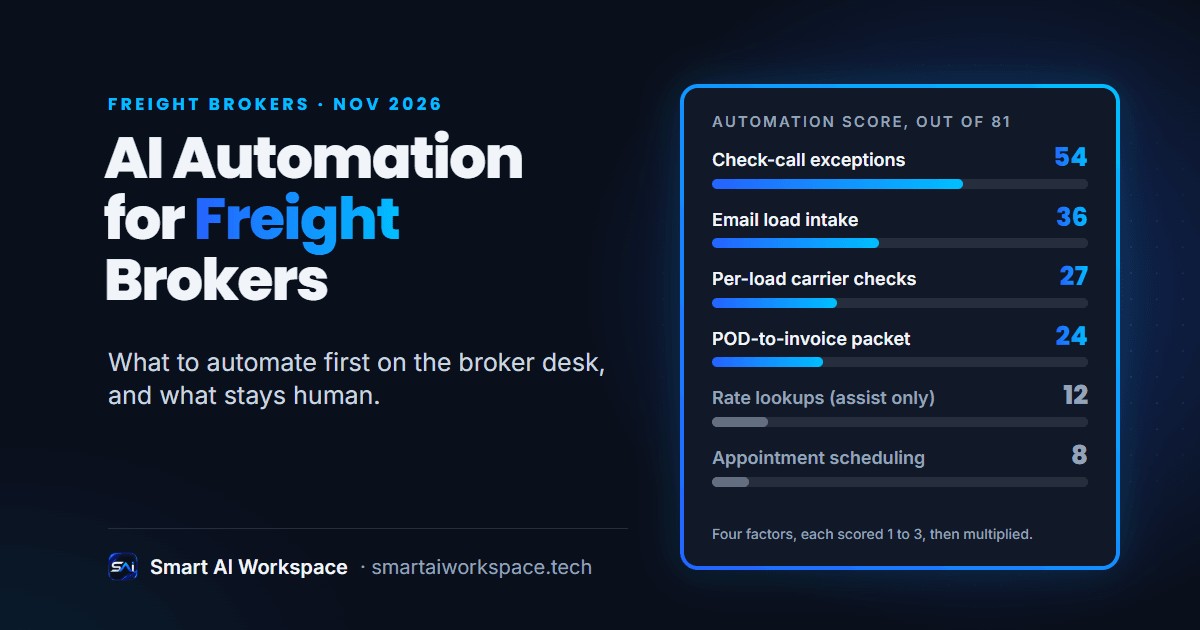
If you run a freight brokerage of 5 to 50 people, automate in this order: check-call and status exceptions first, email load intake second, a carrier re-check on every load third, then the POD-to-invoice packet. Let AI assemble rate lookups, but keep the number, the negotiation, carrier relationships, claims and new-carrier approvals with people. That order comes from a score, not a hunch, and the rest of this post shows the score.
This is the brokerage-desk version of my AI automation for logistics guide. That post covers the whole freight back office for brokers, 3PLs, shippers and fleets. This one goes task by task through a broker's day.
What a Freight Broker's Desk Actually Does
Every load runs the same lifecycle. A tender arrives by email, EDI or a shipper portal. Someone looks up a rate, sets a price, finds a truck, vets the carrier, sends the rate con, books the appointment, chases status until delivery, collects the POD, bills the shipper and pays the carrier. Sometimes a claim follows.
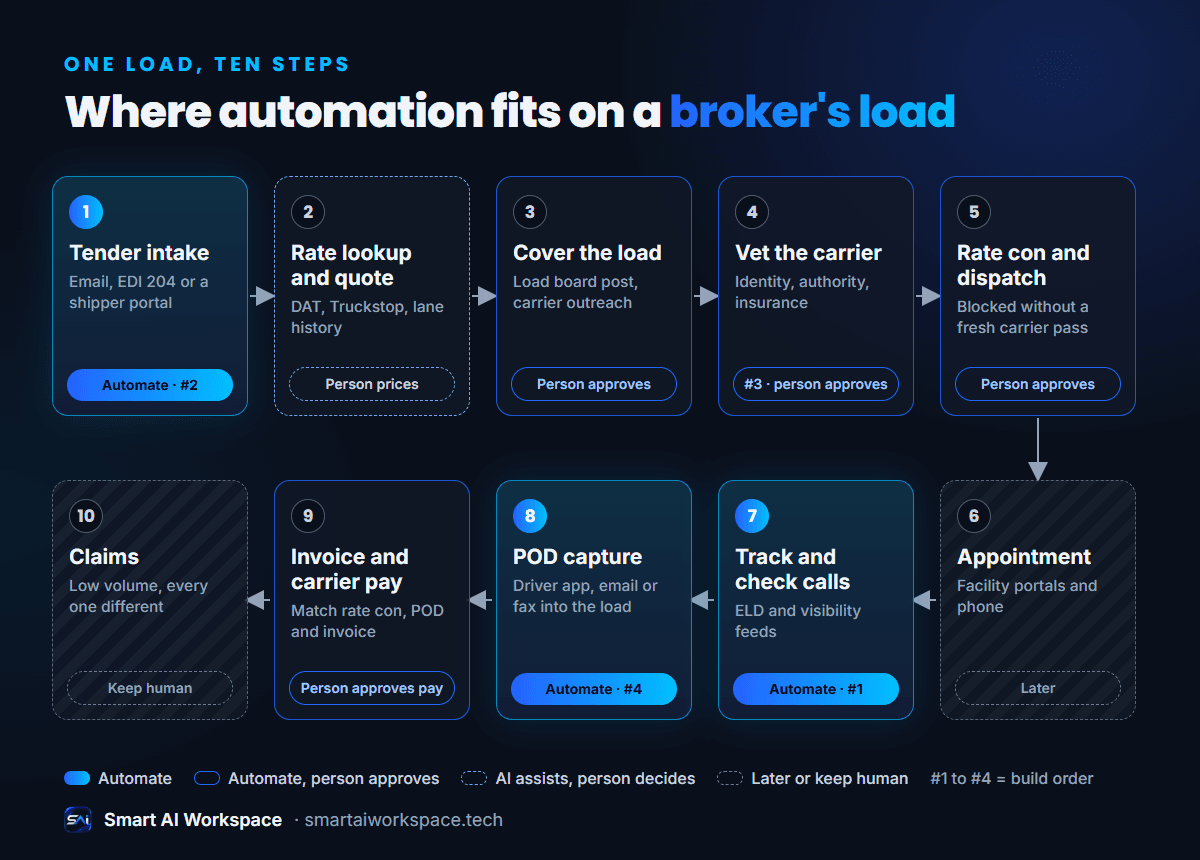
Most of those steps are reading, typing and checking. Vooma's founder, in a sponsored FreightWaves piece, put the load build at about thirty data points that need to be 100% correct. At the large end of the market, C.H. Robinson said in 2024 it received about 11,000 emails a day from shippers and carriers asking for pricing (Supply Chain Dive). A small brokerage gets a fraction of that, with a fraction of the people.
The market doesn't leave room to hire through it. DAT's 2026 outlook told truckload providers not to expect "a dramatic rebound" in 2026 and said broker success "means reducing operating expenses per load through new forms of broker automation." Tabi Connect's August 2026 index put its awarded broker margin at 14.7%, down from 16.5% a month earlier (AJOT). When margin per load is fixed by the market, cost per load is the lever you own.
First, Check What Your TMS and Load Board Already Automate
Before you pay anyone to build, look at what your current subscriptions already do. A lot of it is shipped:
- Tracking inside the TMS. Highway's Load Lock+ is a certified McLeod integration that uses ELD data inside PowerBroker, which the announcement says removes manual check calls.
- Carrier vetting synced to the TMS. The Aljex integration syncs verified carriers from Highway every 5 minutes. MyCarrierPortal and RMIS handle carrier onboarding, and Carrier Assure produces a letter-grade risk score.
- Rate data on the quoting screen. Tai shows DAT RateView on its truckload quoting page, and Rose Rocket lets you rate a lane and post the load from the order.
- Email to TMS. Turvo's partnership with Vooma creates "a seamless bridge from email to TMS for load entry."
Freight-specific AI vendors are also well funded. HappyRobot raised a $150 million Series C at a $1.2 billion valuation in August 2026 for agents that handle phone calls, emails and scheduling (Dealroom). Parade's CoDriver Voice answers inbound carrier calls and can qualify, quote and negotiate. I'm naming them so you know the category exists, not recommending them.
What none of them do is your specific glue: the shipper whose tenders arrive as a spreadsheet, the rule that a reefer load over a certain value needs a second look, the customer who wants updates by text. That gap is where a custom build earns its fee.
The Scoring Rule I Use to Rank Broker Tasks
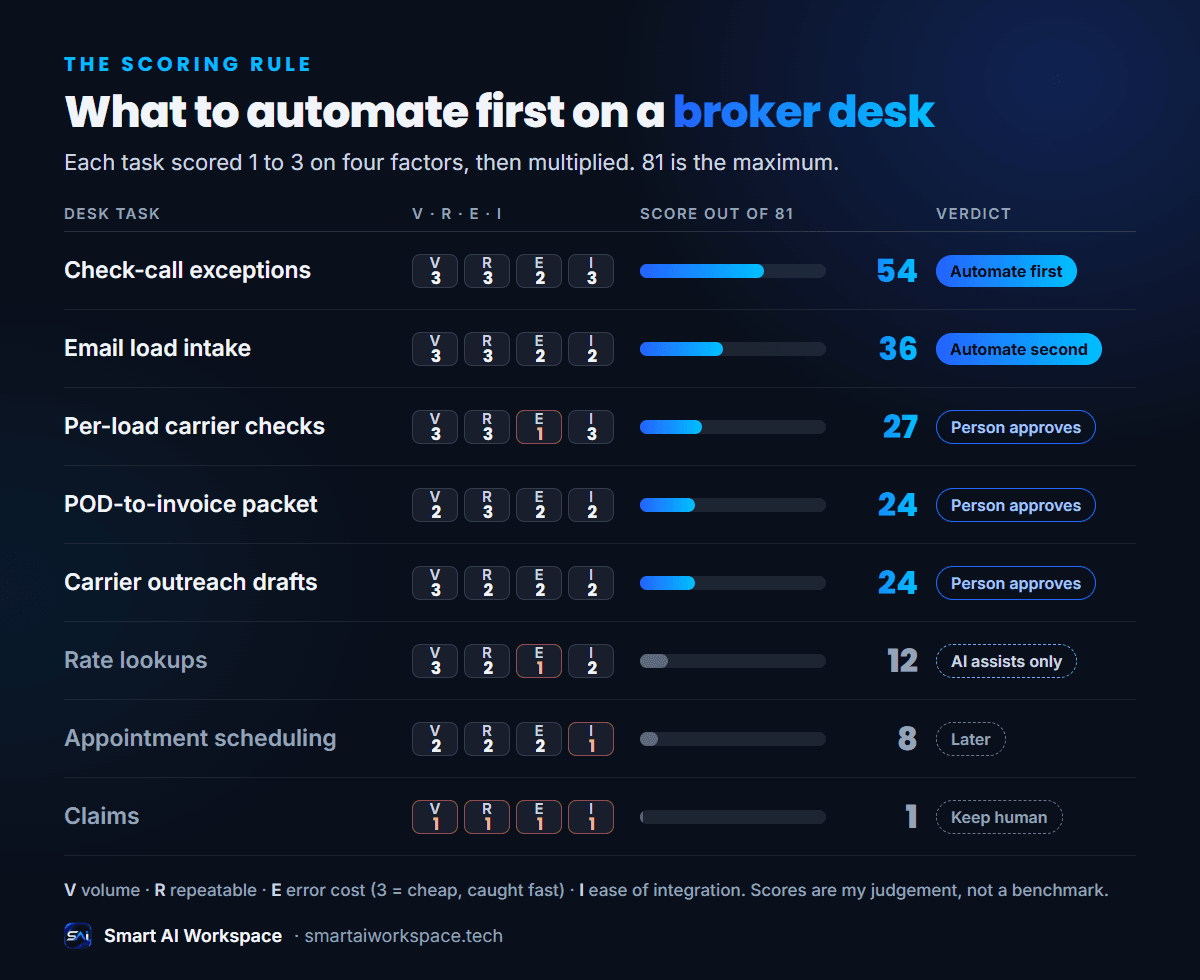
I score each task from 1 to 3 on four questions, with 3 meaning "good for automation", then multiply:
- Volume. How often does it happen per load, per day?
- Repeatability. Could a new hire follow a checklist?
- Error cost. If the automation gets it wrong, how much does it cost and how fast do you catch it? (3 means cheap and caught fast.)
- Ease of integration. Is the data already in an API, a feed or a parseable email?
Multiplying matters. One weak factor drags the whole score down, which is what you want: a high-volume task with a ruinous error cost should not rank first.
| Desk task | Volume | Repeatable | Error cost | Integration | Score | Verdict |
|---|---|---|---|---|---|---|
| Check-call and status exceptions | 3 | 3 | 2 | 3 | 54 | First |
| Email load intake | 3 | 3 | 2 | 2 | 36 | Second |
| Per-load carrier re-checks | 3 | 3 | 1 | 3 | 27 | Third, person approves |
| POD-to-invoice packet | 2 | 3 | 2 | 2 | 24 | Fourth |
| Carrier outreach drafts | 3 | 2 | 2 | 2 | 24 | Fourth |
| Rate lookups (not decisions) | 3 | 2 | 1 | 2 | 12 | Assist only |
| Appointment scheduling | 2 | 2 | 2 | 1 | 8 | Later |
| Claims | 1 | 1 | 1 | 1 | 1 | Keep human |
These scores are my judgement, not a benchmark. Re-score with your own numbers. A brokerage whose tenders all arrive by EDI should drop email intake, and one where every shipper uses a different scheduling portal should leave appointments alone for a long time.
Priority 1: Check-Call Exceptions, Not Check Calls
The tracking itself is mostly bought. If you have Highway, Trucker Tools, MacroPoint or an ELD feed, the location pings already exist. What still eats the day is deciding what each ping means.
So the build is the exception layer. The agent compares every ETA to the appointment window, ignores the loads that are fine, and puts the ones at risk in front of a person with the reason attached: no ping in four hours, ETA past the window, stopped at an unexpected location. It drafts the customer update for the late ones. The person sends it until the drafts are reliably right.
It ranks first because it scores high on all four questions and its mistakes are cheap: a wrong "on time" note gets corrected on the next ping. The logistics guide has the tracking integrations in more detail.
Priority 2: Email Load Intake Into the TMS
A tender email becomes a load: shipper, consignee, pickup and delivery windows, equipment, weight, commodity, reference numbers, rate. The agent reads the email or attachment, fills a draft order, checks it against what it knows (is this a lane the customer ships, does the pickup date make sense, is the weight legal for the equipment), and a person confirms before it's booked.
The pattern is extract, validate, flag. I used it for invoice intake from Gmail, and the rule I'd hold a broker build to comes from a mistake on my own site. My contact form once returned "thanks" while the lead reached nobody, because I'd defined success as "the code finished" instead of "a person can see it." For intake, that means a tender the agent can't parse must land in a visible queue with the reason. It must never vanish. A silently dropped tender is a lost load you'll never hear about.
Priority 3: A Carrier Re-Check on Every Load
Fraud has moved from fake registrations to the inbox and the phone. Highway's Q3 2026 index attributed 40.2% of its stolen-load reports to compromised communications, and fraudulent or spoofed calls it blocked rose 90.3% year over year (FreightWaves; Highway notes this covers its own network only). Verisk CargoNet counted 547 thefts in the US and Canada in Q3 2026, down 33%, but fictitious pickups rose to roughly 25% of incidents and the average theft value for the year so far reached $448,456 (Claims Journal). In TIA's April 2025 survey, 22% of respondents lost more than $200,000 to fraud in six months (TIA).
An onboarding check doesn't catch a carrier whose email was compromised last week. A per-load check can: before the rate con goes out, compare the sender's domain, phone number and ownership details to the carrier record, and re-run your vetting tool's monitoring status.
The design rule comes from my own lead-gen system. It once sent cold email with no opt-out line because the requirement lived in a template, not in the send path. The fix made the send path refuse to run without it. Do the same here: the rate con send should refuse to run without a fresh pass on file. Error cost scores 1 because a missed fraud is expensive, which is why a person still approves every new carrier and every flagged mismatch.
Not sure which desk task to automate first?
I'll score your brokerage's workflows with you and tell you which build has the clearest payback. Free, no obligation.
Priority 4: The POD-to-Invoice Packet and Carrier Outreach
POD to invoice. Match the rate con, accessorials, POD and carrier invoice, then build the shipper invoice and queue the carrier payment. Clean matches move. Mismatches go to a person. In a FreightWaves and OTR Solutions survey (sponsored by OTR), 54% of brokerages called accounts payable mostly automated but only 2% fully automated, and 43% described accounts receivable as partly automated with many manual steps left (FreightWaves). One hard rule: the agent never changes a carrier's remit-to bank details. A changed bank account is a classic fraud move, and only a person who has verified it by phone should touch it.
Carrier outreach. When a load needs a truck, the agent can draft emails to carriers who ran that lane before, using your own history. It ties with billing on score. I'd pick billing first, because it's closer to cash.
Rate Lookups, Not Rate Decisions
Quoting is high volume, which is why it's tempting. But the error cost is the worst on the list. A rate a language model "remembers" is a hallucination with a dollar sign, and a bad quote either loses the load or loses money on it.
So split it. The agent assembles: DAT RateView, Truckstop's rate tools, your own lane history, and a pricing engine if you subscribe to one (Greenscreens.ai, now owned by Triumph, sells rate guidance to brokers). It drafts a quote with every number traced to its source. A person sets the price. And the check is code, not a prompt: a drafted rate outside the band you define, or below your margin floor, is rejected before anyone sees it.
What I Wouldn't Automate Yet
- Rate negotiation. Judgement and leverage, read live.
- Carrier relationship calls. The carriers who take your hard loads at 5 p.m. on a Friday do it because of a person.
- Approving a new carrier. The agent screens. A person decides.
- Claims. Low volume, every one different, and high stakes. Let AI gather the documents. A person handles the rest.
- Appointment scheduling, for now. Every facility portal works differently. It's worth doing once the top four run cleanly.
The other risks are about access. Give the agent read access first and write access only to draft orders, never to carrier banking or rate approvals. Treat every inbound email as untrusted, because a spoofed email is also an attempt to instruct your agent. And keep the record: an agent that writes every charge and payment to the TMS is building the transaction record FMCSA already requires brokers to keep (the logistics guide covers 49 CFR 371.3).
What It Costs and How Smart AI Workspace Approaches It
My published reference ranges, not quotes: $5,000 to $12,000 for a single workflow such as email load intake, $15,000 to $35,000 for a connected build (exceptions, intake, carrier checks and billing), and $1,500 to $6,000 a month for a retainer. How much AI automation costs explains what moves those numbers, and the ROI calculator shows whether a workflow pays for itself.
I run Smart AI Workspace as a founder-led practice, so the person scoring your desk tasks is the person building the agents. I build with Claude-based agentic workflows on top of your existing TMS, load board and vetting tools, not in place of them. Everything starts draft-for-approval, guardrails live in code, and your accounts stay in your name. See AI automation for logistics for the workflows, or what I build.
I haven't delivered a freight brokerage build for a client yet. I have shipped the same pattern elsewhere: an outreach platform for a paying client (5.0 rating on Upwork), the invoice intake above that flags mismatches instead of guessing, and the lead-gen system whose send path refuses to run without its compliance check. If your brokerage would be my first, the free audit tells you whether the build is worth it before you spend anything.
Get Your Brokerage Desk Scored
Send me how your tenders arrive, which TMS you run and where your people spend the day. My free AI automation audit scores your workflows with the rule above and ends with a written proposal. Contact me to book it, see what I build, or check my verified work history on Upwork.
Sources, opened 2026-11-16: Highway Q3 2026 Freight Fraud Index via FreightWaves · Verisk CargoNet Q3 2026 via Claims Journal · TIA: State of Fraud in the Industry (April 2025) · DAT 2026 Freight Focus · Tabi Connect August 2026 index via AJOT · Supply Chain Dive: C.H. Robinson emailed quotes (2024) · FreightWaves: The Journey to the Touchless Load (sponsored by Vooma) · FreightWaves: The Hidden Cost of Manual Processes (sponsored by OTR Solutions) · Highway and McLeod Load Lock+ · Aljex: Highway integration · Tai: DAT integration · Rose Rocket: DAT integration · Turvo and Vooma · Dealroom: HappyRobot Series C · FreightWaves: MyCarrierPortal and Carrier Assure · Parade: CoDriver Voice 2.0 · Triumph: Greenscreens.ai acquisition