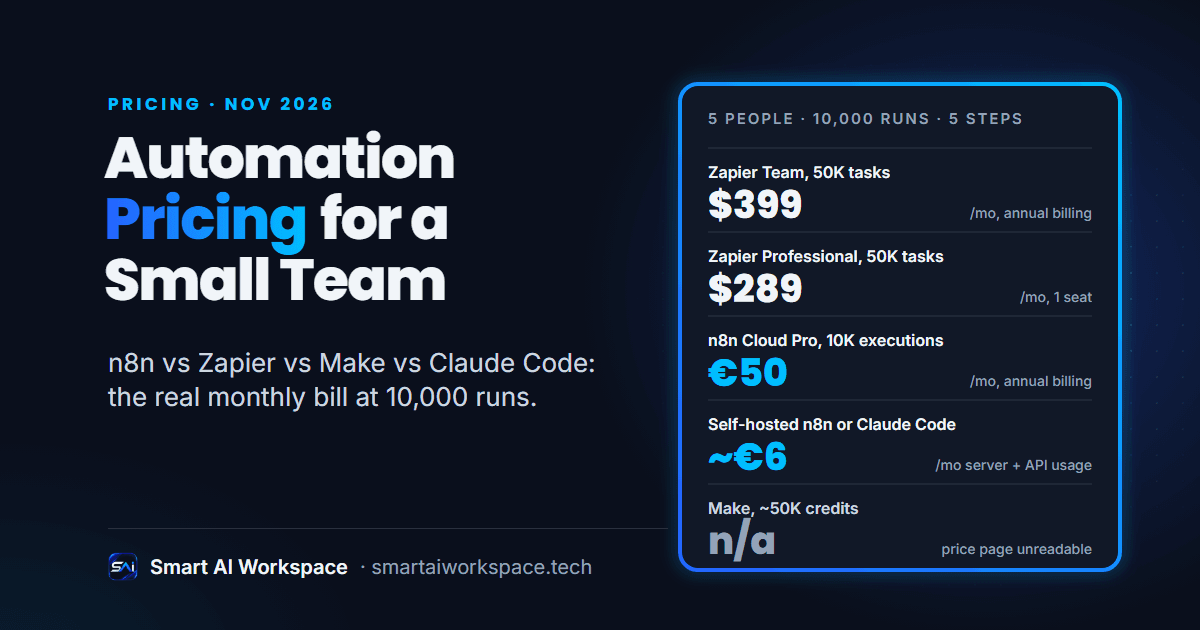
What does AI workflow automation cost a small team in 2026? Between about 6 euros and $399 a month for the same job, depending on the tool and how it counts a run. This post prices one specific scenario on n8n, Zapier, Make and Claude Code, shows where each bill comes from, and adds the costs the pricing pages leave out.
It covers the monthly tool bill only. Features are in n8n vs Zapier vs Make, the one-off project fee is in how much AI automation costs, and the build-versus-platform choice is in n8n vs Claude Code.
How Does Each Tool Count Usage?
Counting is where the bill diverges. The same workflow is a different number of billable units on each platform.
| Tool | Billable unit | What counts | What does not |
|---|---|---|---|
| Zapier | Task | Each successful action step, including AI and Code steps. A Zapier MCP tool call is 2 tasks | Triggers, failed actions, and built-in tools such as Filter, Formatter, Paths, Delay and Looping |
| Make | Credit | Roughly 1 credit per module run, more for some AI features | Router and error-handler modules |
| n8n | Execution | One whole workflow run, whatever its length | Step count and data volume |
| Claude Code | None | No platform meter. You pay hosting and model API usage | Not applicable |
Sources are at the end. All checked on 2026-11-09.
Zapier's overage rule matters for a growing team. With pay-per-task on, extra tasks bill at 1.25 times the base rate on annual plans and 2.5 times on monthly plans, and usage stops at 3 times your task subscription. Make says credits are now its billing unit, with extra credits sold in bundles of 1,000 or 10,000.
The Scenario: 5 People, 10,000 Runs a Month
I priced one workflow so the tools can be compared. A new lead arrives (the trigger), then four steps run: enrich the contact, score it with a language model, write it to a CRM, and send a Slack alert. Ten thousand leads a month, shared by a 5-person team.
- Zapier: trigger is free, 4 action steps, so 40,000 tasks a month. The next tier up is 50,000.
- Make: about 5 credits a run, so about 50,000 credits a month.
- n8n: 10,000 executions a month.
- Claude Code: one developer builds it once. It then runs as ordinary code on a server.
Your workflow will differ. A two-step flow is far cheaper on Zapier, and a 20-step flow is far worse. Multiply your own steps by your own volume before you trust any table, including this one.
Monthly Bill for a Small Team, by Tool
| Tool and plan | Platform bill per month | Notes |
|---|---|---|
| Zapier Professional, 50K tasks | $289 annual billing, $433.50 monthly billing | One seat. Fits if one person owns every Zap |
| Zapier Team, 50K tasks | $399 annual billing, $598.50 monthly billing | Up to 25 users, shared Zaps and folders |
| Make | Not verified | Make's page blocks automated reading. About 50,000 credits is 5 times the 10,000-credit base tier |
| n8n Cloud Pro | 50 euros, annual billing | 10K executions: exactly my volume, so no headroom |
| n8n self-hosted (Community Edition) | Free software, plus a server | Small shared servers list from about 6 euros excluding VAT |
| Claude Code (builder plan) | $17 annual or $20 monthly for Pro; Team standard seats $20 annual or $25 monthly | Needed while building, not for each run |
Plan prices checked on 2026-11-09 at zapier.com/pricing, n8n.io/pricing, claude.com/pricing and hetzner.com/cloud (one example provider; shared plans there start at 5.99 to 6.49 euros excluding VAT).
Two caveats on the Zapier row. AI by Zapier steps can cost more than one task depending on the model tier, so a flow with an AI step may land above 40,000 tasks. And 40,000 tasks is only an approximation of your tier: Zapier sells fixed tiers, so a team at 51,000 tasks pays for the next one up.
On Make, I could not read the plan prices. The pricing page returned a bot-protection screen to every automated request I tried, and the help pages that I could read do not list prices. Third-party guides give the 10,000-credit entry tier at anywhere from about $9 to $38 a month depending on plan and billing, and they disagree with each other. I am not putting a figure in the table that I could not confirm. Before you decide, open make.com/en/pricing and price your own credit count.
What Are the Hidden Costs: AI Usage, Hosting and Upkeep?
The platform line is the part you can read on a pricing page. Three costs sit beside it.
Model usage. The scoring step in my scenario calls a language model. If it runs through your own API key, you pay Anthropic directly. I assumed about 1,500 input and 300 output tokens per call, which is 15 million input and 3 million output tokens across 10,000 calls. At Anthropic's list prices that is:
| Model | Input / output per million tokens | 10,000 scoring calls |
|---|---|---|
| Claude Haiku 5.5 | $0.10 / $0.50 | about $3 |
| Claude Sonnet 5.5 | $2 / $10 | about $60 |
| Claude Opus 5.5 | $4 / $20 | about $120 |
The token sizes are my assumption, not a measurement, and Haiku 5.5 is priced at that rate for prompts up to 100,000 tokens. The point is the ratio: the model choice moves this line 40 times, which is more than the choice between most platforms. If the call re-sends a long prompt each time, caching changes it again, as I measured in what my AI agent workspace costs to run.
Hosting. Self-hosted n8n and Claude Code-written code both run on a server you pay for. A small one is cheap. Backups, updates and uptime monitoring are what the cheap price leaves out.
Your time. This is the cost that decides the self-hosting question. Zapier Team at this volume is about $390 a month more than a small server. At an assumed $50 an hour for your time, that gap pays for about 8 hours of upkeep a month. If you spend fewer, self-hosting wins on cost. If a workflow breaks and nobody notices, it does not win on anything.
What I Actually Pay
My numbers are on the Claude side, and I can give them exactly because I measured them.
I pay a flat $20 a month for Claude Pro ($17 a month on annual billing), and Claude Code is included. Across 30 days of heavy agent use, from 2026-09-17 to 2026-10-16, the same tokens would have cost $742.20 at API list prices, which is about 2.7% paid. That is a calculation, not a bill, and it only applies to interactive use inside a plan's limits. An agent running unattended on a server is billed at the API rate. The full breakdown, including the 89% saved by prompt caching, is in the cost post.
On the n8n side, I moved my own site's contact form off a self-hosted n8n webhook on 2026-08-31. My commit message says the webhook "went down roughly weekly, silently dropping contact leads." The replacement is a Next.js route that sends two emails through Resend, and nothing calls a model at runtime. The step-by-step migration has the code, and the case study has the business side. The lesson for a pricing post: the server was cheap, and the dropped leads were not. A cheap platform that fails silently is not cheap.
I am not quoting my own hosting bill here, so the server figure above is a public list price, not mine.
Pricing for AI Content Automation Tools
Content automation is the case where the platform fee shrinks next to model usage. Drafting, rewriting or summarising text is long-prompt, long-output work, and tokens scale with every word. On the scenario above, Opus-class models cost about 40 times what Haiku-class models do for the same call count.
So price a content workflow in this order: pick the cheapest model that passes your quality check, estimate tokens per run from a real sample, and only then compare platforms. A per-task platform also charges you again for each AI step. Where the model call is the expensive part, running it from code with your own key is often the cheaper route, and I measured how much caching alone can move that bill in the cost post above.
Which Automation Platform Gives the Most Value for the Price?
It depends on who edits the workflow and how many steps it has. These are the rules I use:
- Under about 750 tasks a month, one owner, simple steps: Zapier Professional at $19.99 a month (annual billing) is fine. Its Free plan is 100 tasks.
- Many steps per run, volume above a few thousand runs: per-execution pricing (n8n) beats per-task pricing, because the step count stops mattering.
- A non-developer edits it, or it needs many prebuilt connectors: pay for the canvas platform. The time you save is the real value.
- A developer owns it and the logic is mostly custom: code written with Claude Code, on a cheap server, has no per-run fee. You give up the canvas and the run history.
- Anything customer-facing that must not drop data: pay for monitoring wherever it runs. The migration above is why.
This applies the same way to an ecommerce stack: count your steps per order, multiply by your monthly orders, and price that, not the plan name.
How Does Platform Pricing Compare With Agency Pricing?
They are different bills. The numbers above are what you pay vendors every month whoever builds the workflow. An agency or freelancer adds a one-off build fee and sometimes a retainer. I have published reference ranges for that, not quotes: $5,000 to $12,000 for a single workflow, $15,000 to $35,000 for a connected build, and $1,500 to $6,000 a month for a retainer. How much AI automation costs explains what moves them, and my pricing page explains how I price. Platform and model costs run on your own accounts with no markup from me.
How Smart AI Workspace Approaches This
I run Smart AI Workspace as a founder-led practice. Before I recommend a platform I count billable units for your actual workflow, price the model calls from a short pilot with logging on, and put the upkeep hours next to the licence fee. Some workflows stay on Zapier or n8n and some move to code. See what I build, or use the ROI calculator to check whether a workflow pays for itself before you price a tool.
Next Step
If you want your own monthly bill worked out, my free AI automation audit starts with your workflows and your volumes, and ends with a written proposal. Contact me to book it.
Sources, all opened 2026-11-09: Zapier pricing · n8n pricing · Claude plans and pricing · Anthropic API pricing · Make pricing (plan prices not readable) · Make credits help page · Hetzner Cloud