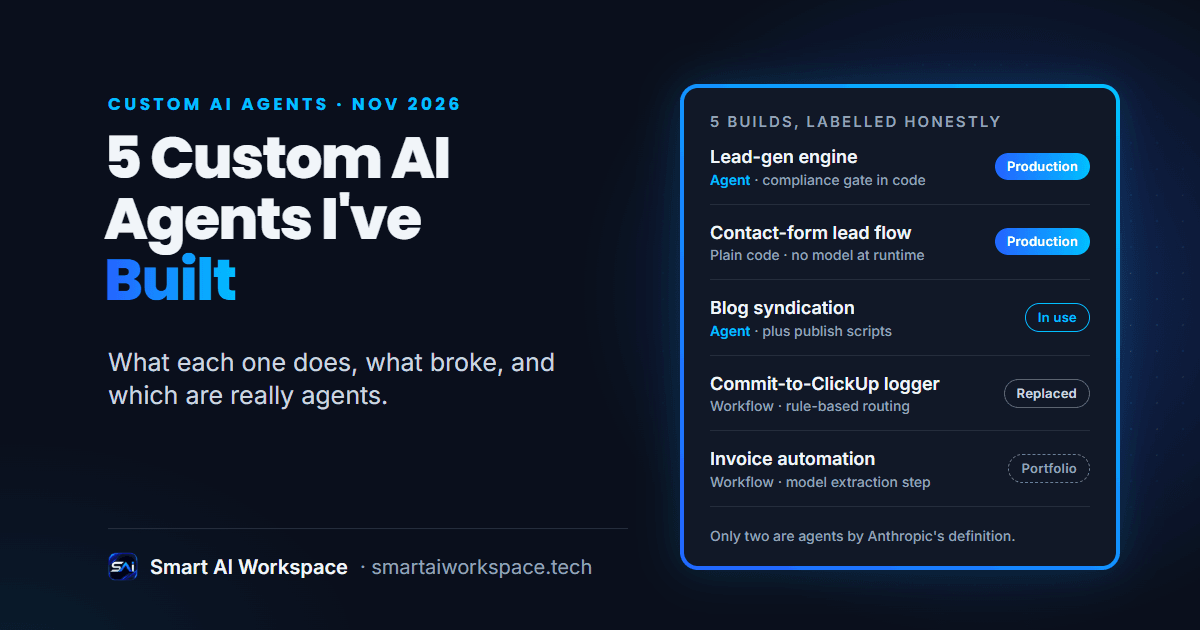
I've built five AI systems for my own business that I'm willing to show a buyer: a lead-gen engine, a contact-form lead flow, a blog syndication pipeline, a commit-to-ClickUp logger and an invoice automation. By Anthropic's definition, only two of them are agents. Two are workflows with a model in the loop, and one runs no model at all once deployed. Below is what triggers each one, what it does, what broke and where it stands today.
What broke is the part most "custom AI agents for business" pages skip, and it's the part that decides whether an agent survives. Gartner predicts over 40% of agentic AI projects will be canceled by the end of 2027, "due to escalating costs, unclear business value or inadequate risk controls" (Gartner). Smaller companies are not catching up either. In McKinsey's 2026 State of AI survey, the share of respondents at smaller organizations who report scaling AI agents stayed flat at 22%, while large organizations rose to 40% (McKinsey).
The 5 Builds at a Glance
| # | Build | Trigger | Agent or workflow | Status |
|---|---|---|---|---|
| 1 | Lead-gen engine with a compliance gate | A scheduled job, weekdays at 10:00 New York time, plus a weekly deliverability check | Agent, with hard gates in code | Production |
| 2 | Contact-form lead flow | Someone submits the form on this site | Plain code, no model at runtime | Production |
| 3 | Blog syndication pipeline | I hand it a topic and my first-hand material | Agent, plus deterministic publish scripts | In use |
| 4 | Commit-to-ClickUp logger | I ran it by hand once a day | Workflow, rule-based routing | Replaced |
| 5 | Invoice automation | An invoice arriving in Gmail | Workflow with a model extraction step | Portfolio piece |
Agent or Workflow: The Definition I Hold Myself To
Anthropic's engineering guide on building effective agents splits "agentic systems" in two. Workflows "are systems where LLMs and tools are orchestrated through predefined code paths." Agents "are systems where LLMs dynamically direct their own processes and tool usage, maintaining control over how they accomplish tasks." The same guide recommends "finding the simplest solution possible, and only increasing complexity when needed. This might mean not building agentic systems at all."
I use that line because the market blurs it. Gartner estimates that "only about 130 of the thousands of agentic AI vendors are real," and calls the relabeling of chatbots, assistants and RPA "agent washing." Its analyst Anushree Verma put it plainly: "Many use cases positioned as agentic today don't require agentic implementations." If I sold you all five systems below as custom AI agents, I'd be doing exactly that.
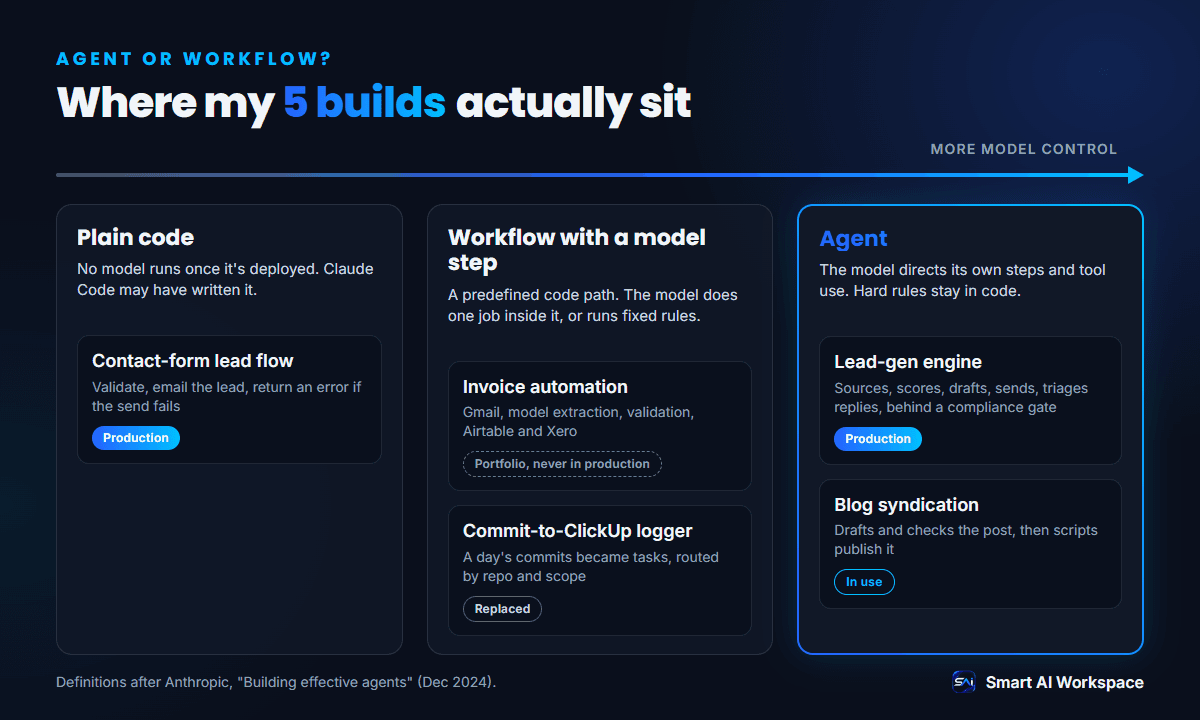
1. The Lead-Gen Engine With a Compliance Gate (Agent)
Trigger. A scheduled job on Trigger.dev, weekdays at 10:00 New York time, runs the pipeline for each client config. My own business is client zero. A weekly /deliverability-monitor check runs alongside it.
Built. First commit on September 8, 2026. Reply triage, verification and deliverability monitoring were in by September 10, the repository went public on September 11, and the daily scheduled job was added on September 27.
What it does. It sources prospects, scores them, drafts each email in my voice, sends, and monitors. A reply-triage skill classifies replies and turns every "stop" into a suppression. The weekly monitor checks SPF, DKIM and DMARC, public blocklists (Spamhaus DBL and ZEN, SURBL, SpamCop, Barracuda) and the bounce rate, then returns one verdict: GREEN, YELLOW or RED. The model writes the drafts and reads the replies, which is why I count this one as an agent.
What broke. Between September 2 and September 13, 2026, it emailed 59 real prospects, 69 messages counting follow-ups, with no opt-out line and no postal address. One bounced (1.7%). The monitor read GREEN the whole time, because nothing it checked covered the law.
The fix. Same day, in commit 901c133 in the public repository: a check_sending() validator in scripts/check_client.py, and the send path now blocks every email for a client without SENDER_POSTAL_ADDRESS set (LinkedIn drafts only). The same commit added an untrusted-input guardrail, so replies, CSVs and enrichment data are treated as data, never as instructions, plus confirmation gates on tools and spend.
Status. Production. Honest caveats: the opt-out is a manual "stop" reply, it sends from my primary domain with no warmed sending domain, and because CAN-SPAM gives 10 business days to honor an opt-out, triage has to run at least twice a week. The full story is in the lead-gen compliance case study.
2. The Contact-Form Lead Flow (Not an Agent, No Model at Runtime)
Trigger. Someone submits the contact form on this site.
What it does. A route on my own site rate-limits to 5 submissions per IP per hour, validates the input against a service allowlist, and emails the lead to my inbox with reply-to set to the person who wrote in. If that send fails, the visitor gets an error (a 502), not a fake "thanks." A confirmation email to the visitor goes out on a best-effort basis and never fails the request.
What broke. The old route wrapped the forward to a self-hosted n8n webhook in an if and returned success either way. That webhook went down roughly weekly, and at least one real lead was lost. The rebuild, shipped on August 31, 2026, surfaced two more problems: with a comma-separated inbox setting, the second address got nothing, and the confirmation email landed in Gmail spam until I moved the sender from a noreply address to my own and added a DMARC record with reporting.
Why it's in a post about agents. Claude Code wrote it, but nothing calls a model when it runs. The old n8n canvas had a GPT-4o-mini lead scorer, and I didn't carry it over. Getting every lead to a person reliably was the job, and code did it. Reply time went from same day to within the hour. The migration steps are in how to replace an n8n workflow with Claude Code, and the business side is in the contact-form case study.
Built. Both commits landed on August 31, 2026.
Status. Production.
3. The Blog Syndication Pipeline (Agent Plus Scripts)
Trigger. I give the blog agent a topic and the first-hand material for the post. If I haven't supplied a real example, it's required to ask before drafting.
What it does. A Claude Code agent drafts the post, then runs my anti-spam checklist on it: a first-hand section, every stat opened at its source, zero em dashes, no more than two posts a week. After the post is live, two scripts syndicate it the same day: a summary to Blogger by email, and a draft on dev.to with its canonical URL pointing back to this site. This post was drafted by that agent.
What broke. The first Blogger route used the Blogger API, and Google's OAuth consent-screen publishing step wouldn't complete. On August 30, 2026 I switched to Blogger's post-by-email. That fixed delivery and created a second problem: an emailed post can't carry a canonical tag, so a full copy on Blogger would compete with the original in search. Since October 6, 2026, Blogger gets the intro and a "Read the full post" link, nothing more.
Agent or workflow. Both. The drafting and the checklist pass are agent work, because the model decides structure, sources and edits. The publishing scripts are fixed code paths, and dev.to stays a draft until I review it.
Built. Blogger post-by-email on August 30, 2026, and the anti-spam gate on October 6, 2026.
Status. In use.
Not sure whether you need an agent or a workflow?
Tell me the job you want automated and I'll tell you which one fits, what it would cost to run, and where it's likely to break. Free, no obligation.
4. The Commit-to-ClickUp Logger (Workflow)
Trigger. Me, by hand, once a day. It was never scheduled. It read that day's commits from local git log --all, which also catches unmerged branches the GitHub API misses.
What it did. Each commit became a ClickUp task assigned to me, plus a "Dev Log" rollup task for the day. It was idempotent: before creating anything it searched for the rollup and the commit SHAs, so a second run didn't duplicate tasks. Routing followed rules by repository and commit scope: blog, content, SEO and GEO commits went to my content pipeline list, other scopes went to the SEO sprint list, and other repositories went to a daily to-do list. The routing is fixed in config, so this is a workflow, not an agent.
What broke. On September 15, 2026, content tasks landed in a list with the right name under the wrong folder (my Upwork folder). I moved the 5 tasks and fixed the config. The lesson: verify the folder a list sits in, not just its name. Then on September 22, Claude Code's auto-mode safety classifier blocked the raw personal API token the script used in the shell. The guardrail was right. I moved the integration to Composio's ClickUp toolkit, which holds the credential server-side, so no token sits in my terminal at all.
Status. Retired and replaced. Its successor is a clickup-log skill that logs a session's deliverables through Composio rather than raw commits, creates tasks in batches of five or fewer, and caps itself at 100 calls a day.
5. Invoice Automation (Portfolio Piece, Workflow With a Model Step)
Label first. This one had no client, went through 23 debug runs over 2 days, and was never deployed to production. I built it to prove the pattern, and I'm listing it as a portfolio piece because that's what it is.
Trigger. An invoice arriving in Gmail.
What it does. A FastAPI service with a SQLite store pulls the invoice from Gmail, extracts the fields with a vision model, validates them, and writes the result to Airtable and Xero. Xero OAuth went in on July 26, 2026, the suite has 37 passing tests, and I recorded a demo on August 1. The path never changes, and the model only does extraction, so it's a workflow with a model step. The vision model sits behind a provider setting I can switch (Claude, OpenAI or a custom endpoint); the test runs used Qwen VL through a custom endpoint.
Built. July 26 to 29, 2026.
What broke. Two bugs, both in the last step. A status-ordering bug made the Xero push dead code, so it never ran. And the push target was wrong: it pointed at Xero's Demo Company by mistake.
Status. Portfolio piece. Not in production, no client numbers.
What the Five Taught Me About Building Agents for Clients
LangChain's State of Agent Engineering report, a survey of over 1,300 practitioners, found 57% have agents in production and named quality "the production killer," cited by 32% as a top barrier. Every break above was a quality problem, and none was the model being "not smart enough." Here's what I now build into every client agent:
- Define success as the outcome. The contact form's job was "a person can see the lead," not "the code finished."
- Put hard rules in code, not prompts or templates. The lead-gen send path refuses to run without a postal address. A footer in a template can be forgotten once.
- Don't trust a green dashboard to cover what it doesn't measure. The monitor was accurate about deliverability and silent about the law.
- Draft first at the edges. LinkedIn messages stay drafts when the email gate fails, and dev.to posts stay drafts until I review them.
- Treat inbound data as data. A crafted reply email is also an attempt to instruct your agent.
- Check where things land. The right list name in the wrong folder still loses work.
- Use the simplest thing that works. One of my five isn't AI at runtime, and it's the one leads depend on most.
What a Custom AI Agent Costs to Build and Run
My published reference ranges, not quotes: $5,000 to $12,000 for one agent or workflow scoped to a single job, $15,000 to $35,000 for a connected build across several systems, and $1,500 to $6,000 a month for a retainer. How much AI automation costs explains what moves those numbers.
Run cost deserves its own line in the budget. In McKinsey's survey, about 20% of respondents said AI operating costs, including token costs, constrained their AI use.
Here is what each of the five costs me a month:
| Build | Runs on | Monthly cost |
|---|---|---|
| Lead-gen engine | Trigger.dev scheduled job (weekdays 10:00 New York), Vibe Prospecting credits, Gmail, Claude | $50 to $70 |
| Contact-form lead flow | Vercel and Resend | $0 (free tiers at this volume) |
| Blog syndication | Claude Code agent and local scripts, Blogger by email, dev.to API | $0 beyond my Claude plan |
| Commit-to-ClickUp logger | Retired | n/a |
| Invoice automation | Not deployed | Estimate only: $20 to $50 if deployed. It never ran in production. |
My $20 a month Claude Pro plan is shared across all of these, and the token math behind it is in what my AI agent workspace costs to run. The agent with the real bill is the one that buys data and runs every weekday. The plain-code route costs nothing.
How Smart AI Workspace Builds Custom AI Agents
Smart AI Workspace is a founder-led AI automation practice. I build custom AI agents for B2B pipeline work (lead sourcing and scoring, outreach drafts, reply triage and inbound lead intake) for small and mid-sized businesses in the US and Canada, using Claude-based agentic workflows. You work directly with the person who builds the agent.
Every build starts with the question this post keeps asking: does the job need an agent, a workflow, or plain code? Then it runs draft-for-approval, with the hard rules in code and your accounts in your name. The step-by-step method is in how I build agentic workflows with Claude Code, and the service itself is on custom AI agents for business.
All five builds above are my own business's systems, and I've labeled them that way on purpose. When a client build ships, it gets the same treatment: trigger, job, what broke, status.
Get Your First Agent Scoped
Send me the job you want off your plate and the tools it touches. My free AI automation audit tells you whether it needs an agent at all, what it would cost to build and run, and where it's likely to break, and ends with a written proposal. Contact me to book it, see what I build, or check my verified work history on Upwork.
Sources, opened 2026-11-23: Anthropic: Building effective agents · Gartner: Over 40% of agentic AI projects will be canceled by end of 2027 (June 2025) · McKinsey: The state of AI in 2026 · LangChain: State of Agent Engineering · smai-leadgen repository (public, MIT)